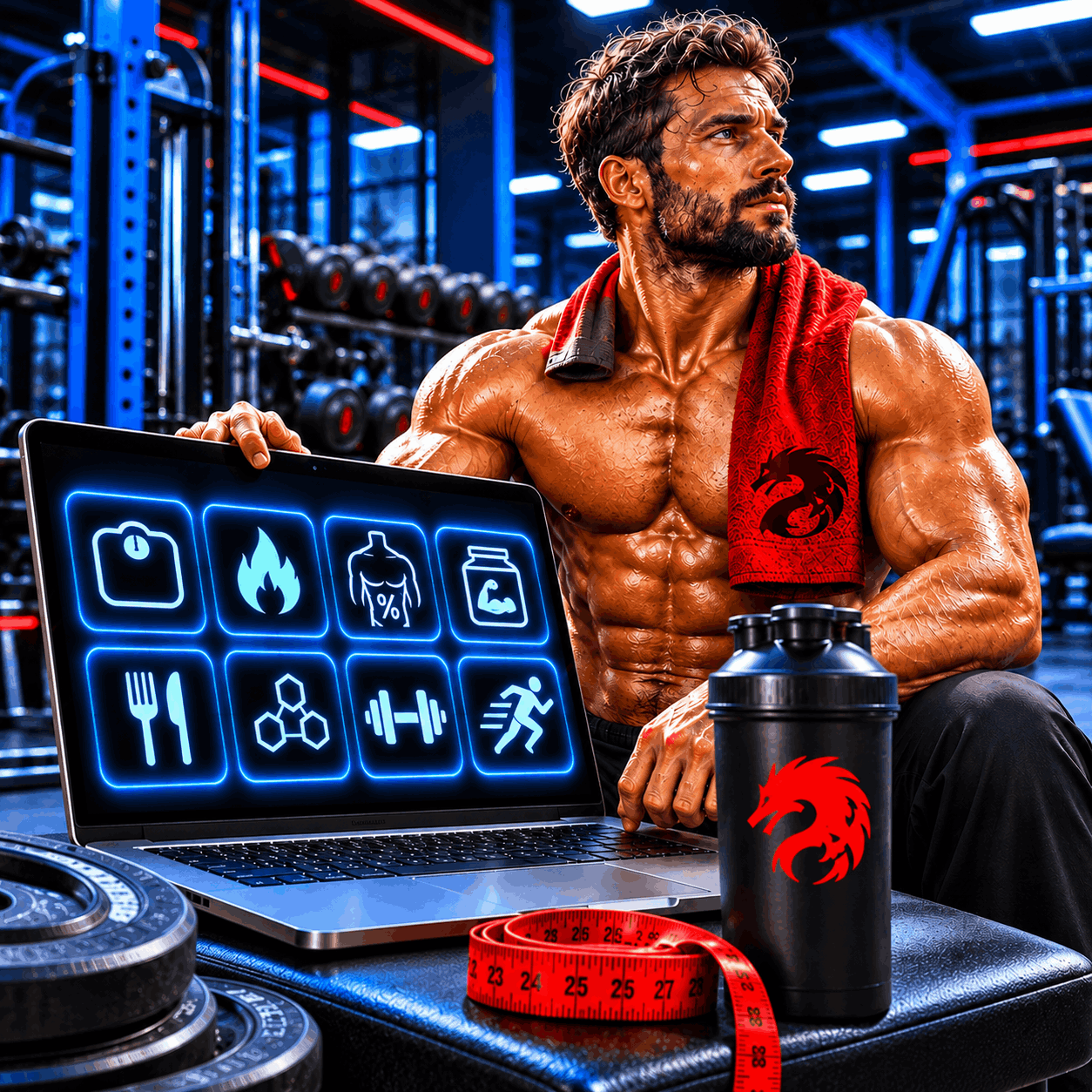
Fitness calculators are practical tools for estimating body composition, nutrition needs, and training performance. They can help you understand your energy needs, track your progress, and organize your nutrition and workout plans.
Drachensang Academy Global offers eight free fitness calculators: Body Mass Index (BMI), daily calorie needs, estimated body fat percentage, protein requirements, macronutrient distribution, one-rep max (1RM), Fat-Free Mass Index (FFMI), and calories burned during physical activity.
How do these tools arrive at their results? Which formulas do they use, and how accurate are their estimates?
This guide explains the underlying principles, provides practical examples, and shows how to use the results for fitness, bodybuilding, muscle growth, and weight management.
Our calculators support US customary and metric measurements, where applicable. You can use pounds, feet, and inches or kilograms and centimeters, with automatic unit conversion in calculators that offer a unit switch.
Important: Fitness calculators primarily provide mathematical estimates. They are not diagnostic tools and cannot replace personalized medical or professional nutrition advice.
1. How Do Fitness Calculators Work?
Fitness calculators process your inputs using mathematical formulas or statistical models. The information required depends on the calculator.
Common inputs include:
- Body weight in pounds (lb) or kilograms (kg)
- Height in feet and inches or centimeters
- Age and, where applicable, sex
- Body measurements such as waist, neck, and hip circumference
- Lifting weight and number of repetitions
- Activity level and workout duration
- Personal nutrition and fitness goals
The calculator uses these inputs to generate a result, often an approximation based on population averages or simplified physiological relationships. When needed, US measurements are converted to metric values internally before calculations.
Why Do Fitness Calculators Use Formulas?
Many physical characteristics cannot be measured directly without specialized equipment. Accurate body composition assessments, for example, require appropriate measurement methods, while actual energy expenditure varies among individuals.
Formulas offer a quick, accessible starting point for planning. They are not substitutes for direct measurements.
What Affects Accuracy?
- Accuracy of the information you enter
- The formula or model used
- Your individual body composition
- Your training experience
- Differences in metabolism and daily activity
- Measurement technique and conditions
Reliable inputs and an appropriate model make estimates more useful.
2. The Eight Drachensang Academy Fitness Calculators
Each calculator addresses a different aspect of fitness or nutrition. Understanding its purpose helps you interpret the results appropriately.
2.1 BMI Calculator – Estimate Body Mass Index
Body Mass Index compares your weight with your height. It is commonly used as a broad screening measure for adult weight categories.
The formula is:
BMI = weight (kg) / height (m)²
Example: 176.4 lb (80 kg) at 5 ft 11 in (approximately 1.80 m).
80 / (1.80 × 1.80) ≈ 24.7.
For adults, a BMI from 18.5 to less than 25 is commonly classified as the standard weight range. BMI does not distinguish muscle from fat or show where body fat is distributed.
It can therefore be misleading for muscular individuals whose higher body weight partly reflects greater muscle mass.
Best for: an initial, general assessment of weight relative to height.
➔ OPEN THE BMI CALCULATOR
2.2 Daily Calorie Calculator – Estimate Energy Needs
Your daily calorie needs are an estimate of how much energy your body requires under particular conditions.
Two important concepts are:
- Basal Metabolic Rate (BMR): the energy your body uses at rest to maintain essential functions.
- Total Daily Energy Expenditure (TDEE): estimated daily energy needs including physical activity and other factors.
Our calculator uses the Mifflin–St Jeor equation to estimate BMR and multiplies it by an activity factor to estimate TDEE. It also provides example calorie targets based on your selected goal.
A result such as 2,500 calories per day is a starting estimate, not a direct measurement. Weight trends, training demands, and how you feel over time provide additional context.
Best for: planning nutrition for muscle gain, maintenance, or weight management.
➔ OPEN THE DAILY CALORIE CALCULATOR
2.3 Body Fat Calculator – Estimate Body Fat Percentage
Body fat percentage represents the share of your total body weight made up of fat.
Our body fat calculator uses a circumference-based estimate inspired by the US Navy method. It relies on height and measurements such as the waist, neck, and, where applicable, hips.
Measure consistently at the same locations. Tape placement, posture, and measurement technique can all affect the estimate, which may differ from results obtained with specialized equipment.
Best for: a rough body composition estimate and tracking longer-term trends.
➔ OPEN THE BODY FAT CALCULATOR
2.4 Protein Calculator – Plan Daily Protein Intake
Protein supplies amino acids used to build and maintain body tissues, including muscle. Individual requirements vary with body weight, activity, training, and nutrition goals.
For adults who train regularly, reference ranges often fall around 1.2–2.0 grams per kilogram of body weight daily, although appropriate amounts depend on individual circumstances.
Example:
176.4 lb (80 kg) × 1.6 g/kg = 128 g of protein per day.
This illustrates the calculation; it is not an individualized dietary prescription.
Our protein calculator adjusts its example range and target according to your selected goal and training level. Overall diet quality matters alongside protein intake.
Best for: strength training, muscle growth, and organizing daily protein intake.
➔ OPEN THE PROTEIN CALCULATOR
2.5 Macro Calculator – Protein, Carbs, and Fat
Macronutrients provide energy and support different bodily functions:
- Protein: approximately 4 calories per gram.
- Carbohydrates: approximately 4 calories per gram.
- Fat: approximately 9 calories per gram.
The macro calculator divides a chosen daily calorie target among protein, carbohydrates, and fat using example percentages for your nutrition goal.
Example at 2,400 calories per day:
30% protein = 720 calories = 180 g.
45% carbohydrates = 1,080 calories = 270 g.
25% fat = 600 calories ≈ 67 g.
These percentages are examples, not fixed scientific requirements. Protein needs in particular may warrant a separate check based on body weight.
Best for: organizing your daily food intake and macro targets.
➔ OPEN THE MACRO CALCULATOR
2.6 One-Rep Max Calculator – Estimate Maximum Strength
One-rep max (1RM) refers to the most weight you can lift once with proper technique in a specific exercise. Rather than attempting a true maximum lift, you can estimate it from a known weight and the number of clean repetitions completed.
Our calculator offers both the Epley and Brzycki formulas. One commonly used estimate is:
Estimated 1RM = weight × (1 + reps / 30)
Example: 176.4 lb (80 kg) for 5 repetitions.
80 × (1 + 5 / 30) ≈ 93.3 kg (205.7 lb).
Actual strength depends on the exercise, technique, training experience, and fatigue. Our calculator limits input to 1–12 repetitions because estimates can become less reliable at higher rep counts.
An estimate does not guarantee you can safely lift the calculated weight. Use proper technique and appropriate safety precautions.
Best for: planning strength-training intensities and monitoring progress.
➔ OPEN THE ONE-REP MAX CALCULATOR
2.7 FFMI Calculator – Assess Fat-Free Mass Relative to Height
Fat-Free Mass Index (FFMI) compares estimated fat-free mass with height. Fat-free mass includes muscle as well as bones, organs, water, and other nonfat tissues.
It requires body weight, height, and estimated body fat percentage.
Fat-free mass = weight × (1 − body fat % / 100)
FFMI = fat-free mass (kg) / height (m)²
Example: 176.4 lb (80 kg), 15% body fat, and approximately 5 ft 11 in (1.80 m).
Fat-free mass = 68 kg (149.9 lb).
FFMI = 68 / 3.24 ≈ 21.0.
The calculator also provides a height-adjusted FFMI using the reference height of 1.80 m. FFMI is not a direct measure of muscle tissue, and its accuracy depends heavily on the body fat estimate.
FFMI alone cannot reliably establish whether someone has used performance-enhancing substances.
Best for: additional context when monitoring body composition in strength sports and bodybuilding.
➔ OPEN THE FFMI CALCULATOR
2.8 Calories Burned Calculator – Estimate Activity Energy Expenditure
Calories burned during exercise depend on factors such as body weight, activity type, intensity, and duration.
Our calculator uses MET values. MET stands for Metabolic Equivalent of Task and describes activity intensity relative to resting energy expenditure.
Estimated calories ≈ MET × body weight (kg) × duration (hours)
Example: 176.4 lb (80 kg), 1 hour at an assumed 5 MET.
5 × 80 × 1 ≈ 400 calories.
This is an estimate of total energy expenditure during the activity, including energy that would have been used at rest. The calculator also estimates additional calories above resting expenditure.
For running, the activity options display approximate speeds in miles per hour, with metric equivalents where useful. Actual expenditure may differ because of training intensity, efficiency, and individual characteristics.
Best for: comparing activities and estimating workout energy expenditure.
➔ OPEN THE CALORIES BURNED CALCULATOR
3. How Should You Interpret Fitness Calculator Results?
Always consider estimates in the context of your goals. No single result fully describes your health, fitness, or nutrition needs.
For Muscle Growth
Estimated calorie needs, daily protein intake, and strength trends can all support muscle-building plans. A one-rep max estimate can help track changes over several weeks.
However, an increase in strength does not necessarily mean muscle mass has increased by the same proportion. Technique, coordination, and experience also affect performance.
For Weight Management
Calorie and activity calculators can provide starting points for nutrition planning. Your body weight trend over several weeks is often more informative than a single calculated calorie target.
Short-term weight fluctuations may also reflect changes in hydration rather than body fat.
For Body Composition
BMI, body fat percentage, and FFMI describe different aspects of the body. BMI uses only weight and height; body fat estimates aim to approximate fat mass; FFMI relates estimated fat-free mass to height.
None should be used alone as a complete assessment of physical condition.
4. How Accurate Are Fitness Calculators?
Accuracy depends on how well the model fits the individual and how reliable the input measurements are.
Estimates Are Not Direct Measurements
A calorie calculator does not directly measure your metabolism. A body fat calculator does not directly measure fat mass. A one-rep max calculator does not test your actual maximum lift.
These tools use mathematical models to estimate possible values.
Individual Differences Matter
People with similar height and weight can differ significantly in muscle mass, daily movement, metabolism, and training status. Identical calculator inputs do not guarantee identical real-world needs.
Track Changes Over Time
Repeated measurements under similar conditions can help you recognize longer-term trends. Small changes may still reflect normal measurement variation rather than actual physical change.
5. Common Fitness Calculator Mistakes
Entering Inaccurate Measurements
Even small differences in height, weight, or circumference can change results. Use current measurements and verify the selected units. Do not confuse pounds with kilograms or inches with centimeters.
Overestimating Activity Level
A hard workout does not automatically mean your entire day is highly active. Selecting an activity level that is too high can inflate estimated calorie needs.
Treating Estimates as Exact Targets
A result of 2,500 calories per day does not mean your body uses exactly that amount every day. Use the number as a starting point and evaluate longer-term trends.
Measuring Body Fat Inconsistently
Different tape positions, posture, or measurement tension can change circumference-based body fat estimates. Measure under comparable conditions.
Entering Unreliable Strength Results
Use repetitions completed with controlled, consistent technique. Assistance, momentum, or a substantially different range of motion can make the 1RM estimate less meaningful.
Double-Counting Exercise Calories
Calories burned during a workout should not automatically be added in full to an estimated daily calorie target. If your activity factor already includes regular exercise, doing so can count the same activity twice.
6. How to Combine Fitness Calculators Effectively
The eight calculators complement one another when used for their intended purposes.
Example: Planning for Muscle Growth
- Use the daily calorie calculator to estimate maintenance energy needs.
- Use the protein calculator to estimate a daily protein range.
- Use the macro calculator to divide your planned calories among protein, carbs, and fat.
- Use the 1RM calculator to monitor estimated strength progress.
- Optionally track body fat and FFMI for additional body composition context.
Review your training performance, body weight trends, and overall well-being regularly to decide whether adjustments are needed.
Example: Weight Management
- Estimate your total daily energy expenditure.
- Develop a balanced nutrition plan appropriate for your goals.
- Consider daily protein and macronutrient intake.
- Use activity calorie estimates as supporting information, avoiding double-counting.
- Track weight trends over several weeks rather than focusing on individual daily readings.
Numbers are only part of the picture. Recovery, sleep, regular physical activity, and a balanced diet remain important.
7. Frequently Asked Questions About Fitness Calculators
Are Online Fitness Calculators Reliable?
They can provide useful estimates when inputs are accurate and the formula suits the purpose. They do not replace direct, individualized measurements.
Which Calculator Is Best for Beginners?
BMI and daily calorie calculators are often easy starting points. The most useful additional tools depend on your goals.
Can I Calculate My Exact Calorie Needs?
No. Online tools estimate energy needs, which can change with body weight, activity, and circumstances.
Is BMI Useful for Bodybuilders?
BMI has limitations for highly muscular individuals because it cannot distinguish fat from muscle.
Can I Estimate Body Fat Without Specialized Equipment?
A measuring tape and an appropriate formula can provide an approximation, but not an exact body composition measurement.
How Often Should I Recalculate My Fitness Numbers?
That depends on the metric. Body weight can be monitored more frequently, while circumference measurements and strength estimates may be more useful at longer intervals. Consistent conditions matter more than constant recalculation.
Can a 1RM Calculator Replace a Maximal Strength Test?
It can estimate a possible maximum, but cannot confirm that you can lift the result safely or successfully.
Does FFMI Measure Muscle Mass Exactly?
No. FFMI is based on all fat-free tissue, not muscle alone, and depends on the accuracy of the body fat estimate.
Are the Fitness Calculators Free?
Yes. All eight Drachensang Academy Global fitness calculators are free to use online.
8. Limitations and Responsible Use
Fitness calculators are intended for general guidance and cannot replace medical, physiological, or professional nutrition assessments.
Many formulas were developed using particular study populations and may not apply equally well to everyone.
Standard adult formulas may be inappropriate for children and teenagers, during pregnancy, for certain medical conditions, or in other special circumstances.
Highly trained athletes may also differ from population averages because of their body composition.
If you have health concerns or condition-specific nutrition requirements, consult a qualified healthcare professional.
Key principle: Treat calculator results as helpful tools, not the sole basis for decisions about health, nutrition, or training intensity.
Conclusion – Get More From Your Fitness Calculators
Fitness calculators can help you understand body measurements, energy needs, and training performance.
BMI offers a general weight-to-height comparison, while body fat percentage and FFMI add context about body composition.
Daily calorie, protein, and macro calculators support nutrition planning. The 1RM calculator estimates maximum strength, and the calories burned calculator provides approximate energy expenditure for physical activity.
These results are estimates, not fixed facts. Individual differences, measurement errors, and changing daily routines all matter.
Using the tools together and following longer-term trends can help you plan workouts and nutrition more systematically.
Explore All Eight Fitness Calculators
Try our free online tools for BMI, daily calories, body fat, protein, macros, one-rep max, FFMI, and calories burned.
➔ VIEW ALL FITNESS CALCULATORS
Discover More Fitness Knowledge
At Drachensang Academy Global, you can explore more
information about fitness, bodybuilding, muscle growth,
training, and nutrition.
➔ EXPLORE DRACHENSANG ACADEMY KNOWLEDGE
Disclaimer:
All calculations and information are intended for general
guidance only. They do not constitute a medical diagnosis
and cannot replace personalized advice from qualified
professionals.