DIANABOL (METHANDIENONE): EFFECTS, RISKS & IMPORTANT FACTS
Dianabol, also known by the active ingredient names
methandienone and methandrostenolone,
is a synthetic anabolic-androgenic steroid (AAS)
structurally related to testosterone.
Introduced in the 1950s, the compound later became
widely associated with bodybuilding, strength sports,
and performance-enhancing drug use.
Dianabol is frequently discussed in connection with
rapid changes in body weight, muscle size, and strength.
However, these reported effects must be considered
alongside potentially serious health consequences.
An important safety concern is that methandienone
is a 17-alpha-alkylated anabolic steroid.
This chemical characteristic contributes to its
oral activity but is also associated with
an increased risk of liver injury.
A responsible understanding of Dianabol requires
distinguishing between its pharmacological properties,
scientific evidence, personal experiences,
and unsupported bodybuilding claims.
WHAT IS DIANABOL?
Dianabol is a trade name associated with
methandienone (methandrostenolone),
a synthetic anabolic-androgenic steroid.
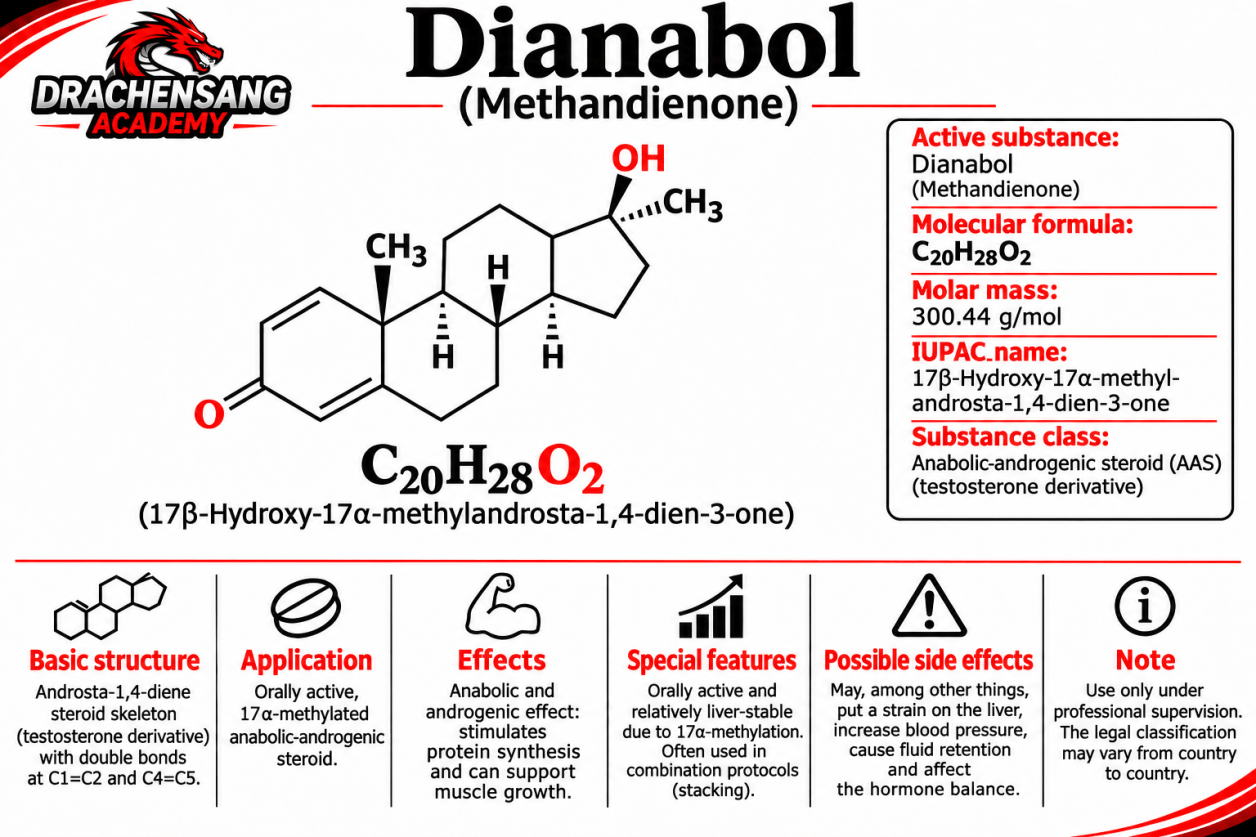
Its molecular formula is C20H28O2,
and its molar mass is approximately
300.44 g/mol.
Methandienone is structurally related to testosterone
and contains modifications that influence its
pharmacological characteristics.
Like other anabolic-androgenic steroids,
it interacts with androgen receptors and
can influence biological processes associated
with protein metabolism and muscle tissue.
Methandienone also has a history of medical use,
although it is not part of routine modern
medical treatment in the United States.
Dianabol is a pharmacologically active
anabolic steroid, not an ordinary dietary supplement.
WHY DID DIANABOL BECOME POPULAR IN BODYBUILDING?
Dianabol became prominent in bodybuilding
because of its anabolic properties and
its association with increases in body weight,
muscle size, and strength.
However, rapid changes in body weight
do not necessarily represent an equivalent
increase in newly developed muscle tissue.
Methandienone can contribute to
fluid and sodium retention,
which may influence body weight
and muscular appearance.
This distinction is important when evaluating
claims about rapid muscle development.
Changes in body weight alone cannot establish
the amount of actual muscle tissue gained.
DIANABOL AND MUSCLE DEVELOPMENT
The anabolic properties of methandienone
are associated with biological processes
involved in protein metabolism and
the maintenance or development of muscle tissue.
However, muscle development also depends on
several important physiological and lifestyle factors.
These include:
• Progressive resistance training
• Adequate energy intake
• Sufficient dietary protein
• Appropriate recovery periods
• Consistent sleep
• Long-term training progression
Short-term changes in strength, muscle volume,
or body weight do not provide reliable information
about the long-term health consequences
of anabolic steroid exposure.
THE LIVER: A MAJOR SAFETY CONSIDERATION
One of the most important health concerns
associated with Dianabol is its potential
effect on the liver.
Methandienone belongs to the group of
17-alpha-alkylated anabolic steroids.
This structural modification contributes
to oral activity but is also associated
with an increased risk of liver toxicity.
Reported liver-related complications
associated with this class of steroids include:
• Elevated liver enzyme levels
• Cholestasis
• Jaundice
• Drug-induced liver injury
• Serious liver complications in some cases
Medical literature includes reports
of cholestatic liver injury associated
with methandienone exposure.
The severity of liver-related effects
can vary between individuals and
according to the circumstances of exposure.
The fact that Dianabol is taken orally
does not make it safer than other
anabolic steroid preparations.
EFFECTS ON THE HORMONAL SYSTEM
External anabolic-androgenic steroids
can interfere with the body's
natural endocrine regulation.
This involves the
hypothalamic-pituitary-gonadal (HPG) axis,
which regulates important aspects of
testosterone production and reproductive function.
External androgen exposure may suppress
the body's natural production of sex hormones.
Potential consequences include:
• Reduced endogenous testosterone production
• Changes in sperm production
• Impaired fertility
• Changes in testicular function
• Changes in libido and sexual function
• Hormonal symptoms after discontinuation
The severity and duration of these effects
vary between individuals.
Recovery of natural hormonal function
may take considerable time and cannot
be guaranteed in every case.
ESTROGEN-RELATED EFFECTS
Methandienone may also produce
estrogen-related effects.
These can include fluid retention
and gynecomastia, which refers
to enlargement of glandular breast tissue
in males.
Such changes may involve more than
cosmetic concerns and can require
medical evaluation.
The occurrence and severity of these effects
cannot be reliably predicted for every individual.
CARDIOVASCULAR HEALTH AND BLOOD PARAMETERS
The potential health risks associated
with Dianabol extend beyond the liver.
Research involving anabolic-androgenic
steroid users has identified associations
with changes in cholesterol levels,
blood pressure, and cardiovascular function.
Potential concerns include:
• Reduced HDL cholesterol
• Increased LDL cholesterol
• Elevated blood pressure
• Fluid retention
• Changes in cardiac structure or function
• Increased cardiovascular strain
Androgen exposure can also influence
red blood cell production and
certain blood parameters.
However, many cardiovascular studies
involve individuals using multiple
anabolic steroids.
Consequently, findings from these studies
cannot always be attributed specifically
to methandienone.
Limited compound-specific evidence
does not establish cardiovascular safety.
OTHER POTENTIAL SIDE EFFECTS
In addition to hepatic, hormonal,
and cardiovascular concerns,
anabolic-androgenic steroids may
affect other physiological systems.
Potential effects include:
• Acne and increased skin oiliness
• Hair loss in genetically predisposed individuals
• Mood changes and irritability
• Changes in libido
• Impaired fertility
• Fluid retention
• Changes in blood parameters
In women, androgen exposure may also
cause virilization, including
voice deepening, increased body hair,
and menstrual disturbances.
Some androgen-related changes
may be irreversible.
Individual responses vary substantially,
and the absence of obvious symptoms
does not establish the absence of
physiological effects.
WHY PRODUCT QUALITY ALSO MATTERS
Another concern involves anabolic steroid
products obtained through unregulated sources.
Such preparations may contain:
• Incorrectly labeled active ingredients
• Unexpected concentrations
• Undeclared pharmacologically active substances
• Contaminants or impurities
The actual composition of an unregulated
product may differ from the information
provided by its seller.
This introduces additional uncertainty
beyond the pharmacological risks
associated with methandienone itself.
Product appearance, branding, or
marketing claims do not establish
pharmaceutical quality or human safety.
DIANABOL IS NOT A DIETARY SUPPLEMENT
An important distinction exists between
pharmacologically active anabolic steroids
and conventional sports nutrition products.
Dianabol is not a dietary supplement.
Protein supplements, creatine, carbohydrates,
and certain vitamins belong to different
product categories from anabolic-androgenic steroids.
Methandienone acts on androgen-responsive
biological systems and may affect
multiple physiological functions.
It should therefore not be presented
or understood as an ordinary
muscle-building supplement.
WHAT IS OFTEN OVERLOOKED ABOUT DIANABOL?
Discussions surrounding Dianabol
frequently emphasize rapid changes
in body weight, muscle size,
and physical strength.
Potential health consequences
may receive considerably less attention.
For methandienone, liver health
is a particularly important consideration
because of its 17-alpha-alkylated structure.
Hormonal suppression, estrogen-related
effects, and possible cardiovascular
complications are also relevant.
Visible changes in physical appearance
cannot reliably indicate the overall
health impact of a pharmacologically
active anabolic steroid.
DIANABOL: EFFECTS AND RISKS AT A GLANCE
Important considerations regarding
Dianabol include:
• Anabolic activity affecting muscle-related processes
• Association with increases in body weight and muscle volume
• Potential fluid and sodium retention
• Significant liver-related health concerns
• Suppression of natural hormonal regulation
• Possible estrogen-related effects, including gynecomastia
• Potential changes in cholesterol and blood pressure
• Possible cardiovascular complications
• Potential effects on fertility and sexual function
• Additional risks from unregulated products
These considerations demonstrate why
the effects of methandienone should
not be evaluated solely by changes
in muscle size or body weight.
IMPORTANT SAFETY INFORMATION
Dianabol (methandienone) is a
pharmacologically active anabolic-androgenic
steroid and is not a harmless fitness
product or dietary supplement.
Nonmedical use may involve significant
risks affecting the liver, hormonal
regulation, reproductive health,
and cardiovascular system.
Drachensang Academy Global
provides this article exclusively
for general educational and
informational purposes.
It does not recommend nonmedical
anabolic steroid use or provide
dosage schedules, cycles,
or combination instructions.
This information does not replace
professional medical advice,
diagnosis, or treatment.
Anyone experiencing health concerns
following anabolic steroid exposure
should seek evaluation from a
qualified healthcare professional.
Symptoms such as yellowing of the skin
or eyes, unusually dark urine, severe
abdominal pain, chest pain, or shortness
of breath require prompt medical attention.
CONCLUSION: UNDERSTANDING DIANABOL
Dianabol, also known as
methandienone or methandrostenolone,
is a synthetic anabolic-androgenic steroid
historically associated with bodybuilding
and strength sports.
Its anabolic properties and association
with increased body weight, muscle size,
and strength must be considered alongside
potential health consequences.
Of particular importance are
liver toxicity, hormonal suppression,
estrogen-related effects, and
cardiovascular health concerns.
Rapid physical changes do not
establish long-term safety or
overall health benefits.
A responsible understanding of
Dianabol requires considering its
pharmacological properties,
scientific evidence, and potential
health risks rather than focusing
solely on short-term changes
in physical appearance.