NANDROLONE: EFFECTS, PROPERTIES, RISKS & IMPORTANT FACTS
Nandrolone is a synthetic
anabolic-androgenic steroid (AAS)
structurally related to testosterone.
It has a history of medical use and research
and is also associated with bodybuilding,
strength sports, and performance-enhancing
drug use.
One of its best-known esterified forms is
nandrolone decanoate, which has been
used in certain medical settings.
Nandrolone is of particular scientific interest
because its chemical structure, metabolism,
and activity in some tissues differ from
those of testosterone.
This article examines its biological properties,
potential effects on muscle tissue,
hormonal regulation, reproductive health,
cardiovascular function, and anti-doping
regulations.
WHAT IS NANDROLONE?
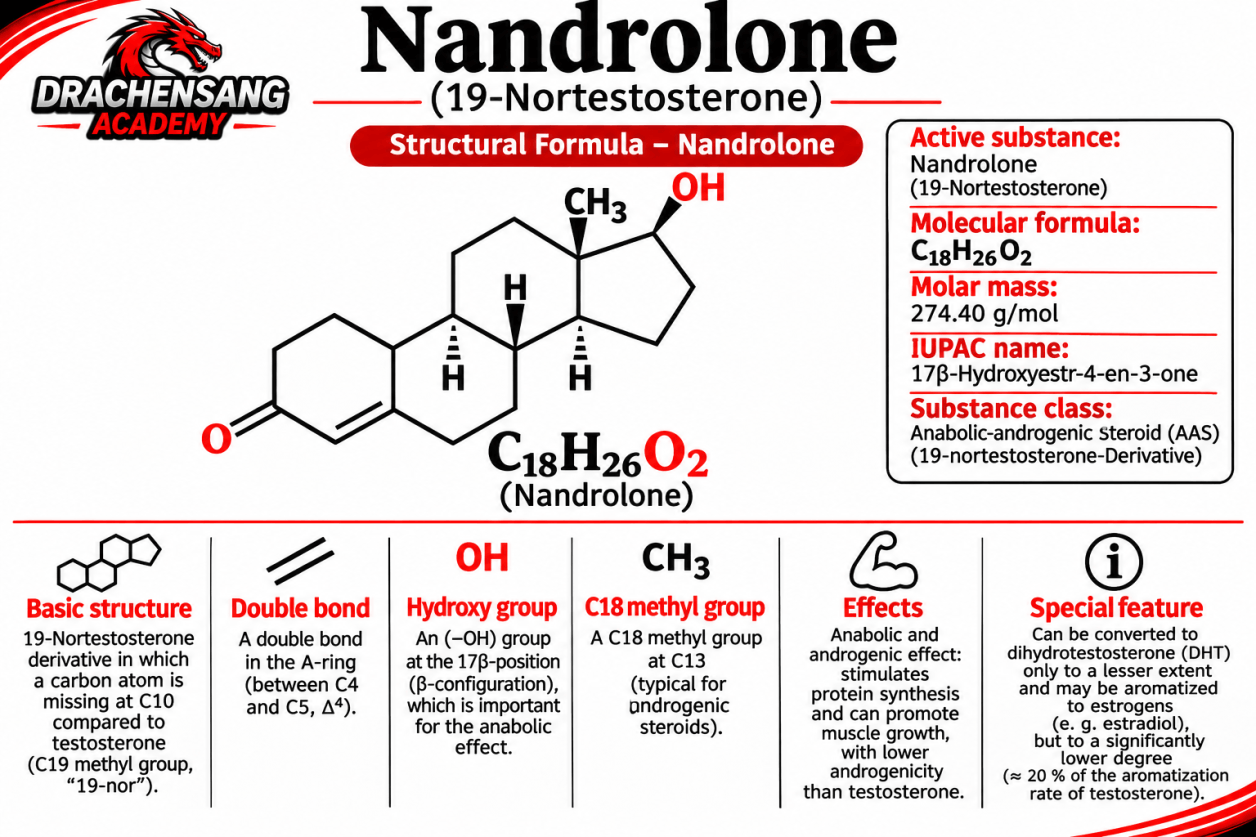
Nandrolone is chemically known as
19-nortestosterone.
Its molecular formula is C18H26O2,
and its molar mass is approximately
274.40 g/mol.
Compared with testosterone, nandrolone
lacks the methyl group at carbon 19
of the steroid structure.
This structural difference influences
its metabolism and pharmacological
characteristics.
Like other anabolic-androgenic steroids,
nandrolone interacts with
androgen receptors,
which influence biological processes
in muscle tissue and other
androgen-responsive organs.
Nandrolone is a pharmacologically
active steroid compound, not an
ordinary dietary supplement.
NANDROLONE AND NANDROLONE DECANOATE
An important distinction exists
between nandrolone itself and
nandrolone decanoate.
Nandrolone is the active
steroid molecule.
Nandrolone decanoate is an
esterified derivative in which
a decanoate ester is attached
to the steroid structure.
This modification affects the
compound's physicochemical
properties and allows prolonged
release from certain injectable
depot formulations.
After ester cleavage, the active
steroid is nandrolone.
The presence of an ester does
not eliminate the risks associated
with androgenic activity.
NANDROLONE AND MUSCLE DEVELOPMENT
Nandrolone has been investigated
in connection with its effects
on lean body mass and
muscle-related processes.
Anabolic-androgenic steroids
can influence protein metabolism
and processes involved in
maintaining or developing
lean tissue.
Studies involving nandrolone
decanoate have reported changes
in lean body mass in selected
medical and research populations.
However, findings from specific
patient groups cannot automatically
be applied to healthy athletes
or bodybuilding populations.
Increased muscle size does not
necessarily indicate equivalent
improvements in strength,
physical performance,
or overall health.
Potential anabolic effects
should not be confused with
evidence of safety in
nonmedical use.
WHY IS NANDROLONE SOMETIMES CALLED A "MILDER" STEROID?
Nandrolone is sometimes described
as having a lower androgenic
profile than testosterone
in certain tissues.
One factor contributing to
these differences is its
metabolism by the enzyme
5-alpha-reductase.
In some androgen-responsive
tissues, this enzyme converts
nandrolone into
5-alpha-dihydronandrolone,
a metabolite with different
androgenic activity.
However, these tissue-specific
differences do not make
nandrolone harmless.
The compound can still affect
the endocrine system,
cardiovascular health,
reproductive function,
and other physiological
processes.
"Milder" is not a recognized
clinical classification
of overall steroid safety.
NANDROLONE AND THE HORMONAL SYSTEM
Exogenous anabolic-androgenic
steroids can interfere with
the body's natural
hormonal regulation.
This involves the
hypothalamic-pituitary-gonadal
(HPG) axis, which plays
an important role in regulating
testosterone production
and reproductive function.
External androgen exposure
can suppress the release
of luteinizing hormone (LH)
and follicle-stimulating
hormone (FSH).
Potential consequences include:
• Reduced natural testosterone production
• Changes in libido
• Reduced sperm production
• Impaired fertility
• Erectile difficulties
• Testicular shrinkage
• Hormonal symptoms after discontinuation
The severity and duration
of these effects can vary
between individuals.
Recovery of normal hormonal
function may take time
and cannot be guaranteed
in every case.
NANDROLONE AND THE CARDIOVASCULAR SYSTEM
Cardiovascular health is
an important concern
associated with nonmedical
anabolic steroid use.
Research involving AAS users
has reported associations
with changes in:
• Blood pressure
• HDL and LDL cholesterol
• Blood parameters
• Vascular function
• Cardiac structure and function
Prolonged or substantial
AAS exposure has also been
associated with serious
cardiovascular complications.
These may include cardiac
muscle abnormalities,
arrhythmias, and
thrombotic events.
However, many studies involve
individuals exposed to multiple
anabolic steroids.
Therefore, findings from
mixed AAS populations
cannot always be attributed
specifically to nandrolone.
Reduced androgenic activity
in certain tissues does
not establish cardiovascular
safety.
POTENTIAL SIDE EFFECTS OF NANDROLONE
The potential effects
of nandrolone extend
beyond muscle tissue.
Research involving nandrolone
and broader anabolic steroid
exposure has identified
several areas of concern.
Hormonal and Reproductive Effects
• Suppression of natural hormone production
• Changes in libido and sexual function
• Reduced sperm production
• Impaired fertility
• Possible gynecomastia
Cardiovascular Effects
• Changes in blood pressure
• Unfavorable blood lipid changes
• Possible cardiac muscle abnormalities
• Increased cardiovascular strain
Skin and Hair
• Acne
• Increased skin oiliness
• Hair loss in genetically predisposed individuals
Psychological Effects
• Mood changes
• Irritability
• Anxiety symptoms
• Sleep disturbances
In women, anabolic-androgenic
steroid exposure may also
cause virilization,
including voice deepening,
increased body hair,
and menstrual disturbances.
Some androgen-related
changes may be irreversible.
Individual risk depends
on several factors,
including health status,
circumstances of exposure,
and other substances.
NANDROLONE IN MEDICINE
Nandrolone has a history
of use in selected
medical settings.
Its esterified preparations
have been investigated
for their effects on
protein metabolism,
lean body mass,
and certain clinical
conditions.
However, medical approval
and availability differ
between countries
and formulations.
In the United States,
nandrolone decanoate
has a history of approved
medical use for certain
conditions, including
anemia associated with
renal insufficiency.
Medical treatment involves
a defined clinical indication,
professional assessment,
and appropriate monitoring.
Medically supervised
treatment is fundamentally
different from nonmedical
use for bodybuilding
or performance enhancement.
NANDROLONE AND ANTI-DOPING REGULATIONS
Nandrolone is included
in the World Anti-Doping
Agency (WADA) Prohibited List
under S1 – Anabolic Agents.
It is prohibited both
in and out of competition
under applicable
anti-doping rules.
Its metabolites are
also relevant to
anti-doping analysis.
These include
19-norandrosterone
and 19-noretiocholanolone,
which can be associated
with nandrolone and
related norsteroids.
Athletes should consult
the current WADA
Prohibited List and
the regulations of
their sports governing body.
NANDROLONE IN BODYBUILDING
In bodybuilding, nandrolone
is primarily discussed
because of its association
with anabolic activity,
muscle development,
and lean body mass.
However, a compound's
ability to influence
muscle-related processes
does not establish that
nonmedical use is safe
or medically appropriate.
Reported physical effects
should be considered
alongside potential
hormonal, cardiovascular,
and reproductive
health consequences.
WHY RELIABLE INFORMATION ABOUT NANDROLONE MATTERS
A large amount of anecdotal
information about nandrolone
can be found online.
Individual experiences
may provide context,
but they cannot replace
controlled scientific
research.
Reported outcomes may
be influenced by:
• Genetic differences
• Training experience
• Nutrition and recovery
• Existing health conditions
• Other medications
• Exposure to additional substances
• Uncertainty about product composition
In cases involving multiple
anabolic steroids, it may
be difficult to identify
which compound contributed
to a particular adverse effect.
Personal reports should
not be treated as equivalent
to controlled clinical evidence.
NANDROLONE: EFFECTS AND RISKS AT A GLANCE
Important considerations
regarding nandrolone include:
• Anabolic-androgenic activity
• Potential effects on lean body mass
• Suppression of natural hormonal regulation
• Possible impairment of fertility
• Potential cardiovascular and blood lipid changes
• Possible skin and hair effects
• Potential psychological effects
• Relevance to anti-doping testing
• Prohibited status under WADA regulations
These considerations highlight
the importance of evaluating
nandrolone beyond its association
with muscle development.
IMPORTANT SAFETY INFORMATION
Drachensang Academy Global
provides this article
exclusively for general
educational and
informational purposes.
Nandrolone is a
pharmacologically active
anabolic-androgenic steroid,
not an ordinary
dietary supplement.
Nonmedical exposure may
involve significant
hormonal, reproductive,
cardiovascular, and
other health risks.
This article does not
recommend nonmedical
anabolic steroid use
or provide dosage schedules,
cycles, or combination
instructions.
This information does not
replace professional
medical advice,
diagnosis, or treatment.
Anyone experiencing health
concerns following anabolic
steroid exposure should
seek evaluation from a
qualified healthcare
professional.
CONCLUSION: NANDROLONE IN CONTEXT
Nandrolone is a
synthetic anabolic-androgenic
steroid structurally related
to testosterone.
Its biological properties
have been studied in
medical and experimental
research for many years.
Although the compound can
influence muscle-related
processes and lean body
mass, it can also interfere
with hormonal regulation
and may be associated with
reproductive, cardiovascular,
and other health concerns.
A meaningful assessment
requires distinguishing
between medically
supervised treatment
and nonmedical use
in bodybuilding or sport.
For competitive athletes,
nandrolone is also relevant
because of its prohibited
status under WADA
anti-doping regulations.
Understanding nandrolone
requires considering its
pharmacological properties,
potential health risks,
and anti-doping relevance
rather than focusing solely
on muscle development.