ORAL TURINABOL: EFFECTS, PROPERTIES, RISKS & DOPING
Oral Turinabol is a synthetic
anabolic-androgenic steroid (AAS)
also known as dehydrochloromethyltestosterone
(DHCMT) or
4-chlorodehydromethyltestosterone.
The compound was developed in the 1960s
and became particularly associated with
the history of competitive sports,
performance enhancement, and doping.
In bodybuilding and strength sports,
Oral Turinabol is often discussed
in connection with muscle development,
strength, and physical performance.
However, its pharmacological effects
must be considered alongside potential
health risks, hormonal disruption,
and its prohibited status in
regulated competitive sports.
This article examines the compound's
chemical characteristics, biological
activity, potential adverse effects,
historical significance, and relevance
to modern anti-doping science.
WHAT IS ORAL TURINABOL?
Oral Turinabol belongs to the class
of anabolic-androgenic steroids
and is structurally related to testosterone.
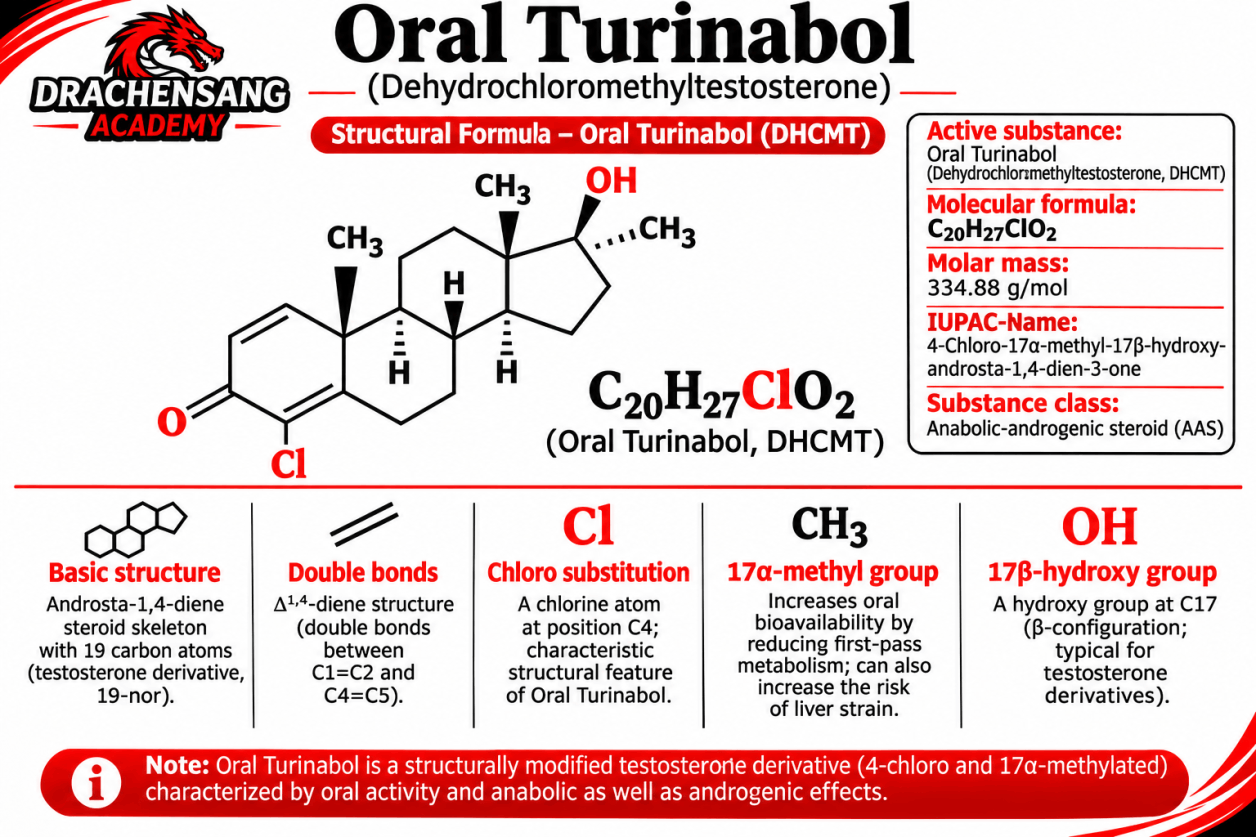
Its active ingredient,
dehydrochloromethyltestosterone,
has the molecular formula
C20H27ClO2 and a molar mass
of approximately 334.88 g/mol.
The compound contains structural
modifications that distinguish it
from testosterone, including a
chlorine substituent and an additional
double bond in the steroid framework.
It is also a 17-alpha-alkylated
steroid, a structural feature
associated with oral activity
and important liver-related
safety considerations.
Like other anabolic-androgenic steroids,
DHCMT can interact with
androgen receptors and influence
androgen-dependent biological processes.
Oral Turinabol is a pharmacologically
active synthetic steroid, not an
ordinary dietary supplement.
ORAL TURINABOL AND MUSCLE DEVELOPMENT
The biological activity of
anabolic-androgenic steroids
is closely associated with
their interaction with
androgen receptors.
Androgen receptor signaling
can influence processes
involved in protein metabolism,
muscle tissue maintenance,
and the development
of lean body mass.
Oral Turinabol became associated
with muscle development and
physical performance in
competitive sports and
bodybuilding environments.
However, controlled modern
human research specifically
examining DHCMT in healthy
athletes is limited.
Therefore, findings from
broader anabolic steroid
research should not automatically
be interpreted as direct
clinical evidence for
Oral Turinabol itself.
Anabolic activity does not
establish that nonmedical
use is safe or medically
appropriate.
WHY IS ORAL TURINABOL ASSOCIATED WITH COMPETITIVE SPORTS?
Oral Turinabol has a
particularly significant
place in the history
of performance-enhancing
drug use.
The compound became strongly
associated with the
state-sponsored doping
program in the former
East Germany.
Historical investigations
documented the administration
of anabolic steroids to
athletes, sometimes without
their fully informed consent.
These practices contributed
to serious ethical concerns
and documented health
consequences.
Today, Oral Turinabol
remains relevant to
anti-doping research
because of its metabolic
characteristics and the
development of analytical
methods capable of identifying
its metabolites.
ORAL TURINABOL AND THE LIVER
The liver is an important
safety consideration
when evaluating orally
active anabolic-androgenic
steroids.
Oral Turinabol is a
17-alpha-alkylated steroid,
a structural modification
that contributes to
its oral activity.
This characteristic is
also associated with
potential liver toxicity.
Reported liver-related
concerns involving
17-alpha-alkylated
anabolic steroids include:
• Elevated liver enzyme levels
• Cholestatic liver injury
• Impaired bile flow
• Jaundice
• Rare but serious hepatic complications
More severe liver conditions
have been reported in
association with prolonged
anabolic steroid exposure,
although the available
evidence does not always
identify DHCMT as the
individual causative compound.
Liver enzyme changes alone
do not establish the
presence or severity
of liver injury.
Oral administration should
never be interpreted as
evidence that a steroid
is harmless.
EFFECTS ON THE HORMONAL SYSTEM
Exogenous anabolic-androgenic
steroids can interfere with
the body's natural
hormonal regulation.
This involves the
hypothalamic-pituitary-gonadal
(HPG) axis, which regulates
important reproductive
hormones and natural
testosterone production.
External androgenic activity
can suppress hormonal
signaling involved in
normal reproductive function.
Potential consequences include:
• Reduced endogenous testosterone production
• Changes in libido
• Reduced sperm production
• Impaired fertility
• Erectile difficulties
• Hormonal symptoms following discontinuation
The severity and duration
of these effects can vary
between individuals.
Evidence from broader
AAS research indicates
that hormonal recovery
may be prolonged in
some individuals.
Short-term physical changes
should therefore be evaluated
alongside potential longer-term
endocrine and reproductive
health consequences.
EFFECTS ON THE CARDIOVASCULAR SYSTEM
Nonmedical anabolic steroid
exposure can affect
the heart and
cardiovascular system.
Research involving AAS
users has identified
potential concerns
including:
• Reduced HDL cholesterol
• Increased LDL cholesterol
• Elevated blood pressure
• Changes in vascular function
• Alterations in cardiac structure and function
Long-term AAS misuse
has also been associated
with more serious
cardiovascular complications.
However, much of this
evidence comes from
individuals exposed
to multiple anabolic
steroids rather than
DHCMT alone.
Consequently, these
findings should not
automatically be attributed
exclusively to Oral Turinabol.
Increased muscle mass
does not necessarily
indicate healthy
cardiovascular function.
ORAL TURINABOL IN WOMEN
Women exposed to
anabolic-androgenic steroids
may experience androgen-related
adverse effects.
These can include:
• Deepening of the voice
• Increased facial or body hair
• Acne and oily skin
• Menstrual disturbances
• Changes in reproductive function
• Other signs of virilization
Some androgen-related
changes, particularly
voice deepening,
may be irreversible.
Historical reports involving
female athletes exposed
to anabolic steroids
illustrate the importance
of recognizing these
potential consequences.
Individual effects depend
on the circumstances
of exposure and cannot
be reliably predicted
from appearance or
short-term performance.
ORAL TURINABOL AND ANTI-DOPING TESTING
Oral Turinabol is prohibited
under the World Anti-Doping
Agency (WADA) Prohibited List.
DHCMT belongs to the
S1 – Anabolic Agents
category and is prohibited
both in and out of
competition under
applicable anti-doping rules.
Its metabolites are
particularly important
in laboratory analysis.
Modern anti-doping methods
can identify characteristic
metabolic products rather
than relying exclusively
on the presence of
the original compound.
Scientific research has
identified DHCMT metabolites
that may remain detectable
after the parent compound
has been extensively
metabolized.
The analytical detection
window varies according
to multiple factors,
including the metabolite,
laboratory method,
and circumstances
of exposure.
No universal detection
period can be reliably
applied to every individual
or testing situation.
Competitive athletes
should always consult
the current WADA
Prohibited List and
their applicable
sports regulations.
WHY CALLING ORAL TURINABOL A "MILD STEROID" CAN BE MISLEADING
In bodybuilding and
fitness discussions,
Oral Turinabol is
sometimes described
as relatively "mild."
However, this informal
description is not
a recognized medical
classification of safety.
Even when certain
visible effects appear
less pronounced than
those associated with
other anabolic steroids,
DHCMT remains a
pharmacologically
active anabolic-androgenic
substance.
Potential effects on
the liver, endocrine
system, blood lipids,
and cardiovascular
health remain important
considerations.
A steroid's safety
cannot be determined
solely by visible
changes in muscle
mass or performance.
ORAL TURINABOL: EFFECTS AND RISKS AT A GLANCE
Oral Turinabol is a
historically significant
synthetic anabolic-androgenic
steroid with recognized
pharmacological activity.
Important considerations
include:
• Anabolic-androgenic activity
• Historical association with performance enhancement
• Potential suppression of natural hormonal regulation
• Possible liver-related adverse effects
• Potential changes in blood lipid levels
• Possible cardiovascular health risks
• Potential reproductive effects
• Risk of virilization in women
• Characteristic metabolites relevant to anti-doping analysis
• Prohibited status under WADA regulations
These considerations
highlight why the
compound should be
evaluated beyond its
association with
muscle development
or athletic performance.
IMPORTANT SAFETY INFORMATION
Drachensang Academy Global
provides this article
for general educational
and informational
purposes only.
Oral Turinabol is a
pharmacologically active
anabolic-androgenic steroid
and is not an ordinary
dietary supplement.
Nonmedical exposure
may involve significant
liver-related, hormonal,
reproductive, and
cardiovascular risks.
This article does not
recommend anabolic
steroid misuse or
provide dosage schedules,
cycles, or combination
instructions.
The information does
not replace professional
medical advice,
diagnosis, or treatment.
Anyone experiencing
health concerns related
to anabolic steroid
exposure should seek
evaluation from a
qualified healthcare
professional.
CONCLUSION: ORAL TURINABOL IN CONTEXT
Oral Turinabol,
also known as
dehydrochloromethyltestosterone
(DHCMT), is a
synthetic anabolic-androgenic
steroid developed
during the 1960s.
Its historical association
with competitive sports
and state-sponsored doping
makes it an important
compound in the study
of performance-enhancing
drug use.
Although its anabolic
properties have contributed
to its reputation in
bodybuilding and
strength sports,
potential health risks
must also be considered.
These include possible
effects on liver function,
hormonal regulation,
reproductive health,
blood lipids, and
cardiovascular function.
Its characteristic
metabolites also make
DHCMT relevant to
modern anti-doping
analysis.
Understanding Oral Turinabol
requires evaluating its
chemical properties,
biological activity,
historical significance,
and potential health
risks as a whole.