OXANDROLONE & ANAVAR: EFFECTS, PROPERTIES, RISKS & IMPORTANT INFORMATION
Oxandrolone is a synthetic
anabolic-androgenic steroid (AAS)
with a history of medical use, including
treatment intended to support weight gain
following certain illnesses, injuries,
or surgical procedures.
The active ingredient has historically
been marketed under the brand names
Anavar and Oxandrin.
In bodybuilding and fitness communities,
oxandrolone is frequently associated with
muscle development, strength, and changes
in body composition.
However, its pharmacological activity
also involves potential effects on the
liver, cardiovascular system,
hormonal regulation, and reproductive health.
Medical treatment must therefore be clearly
distinguished from nonmedical use for
performance enhancement.
WHAT IS OXANDROLONE?
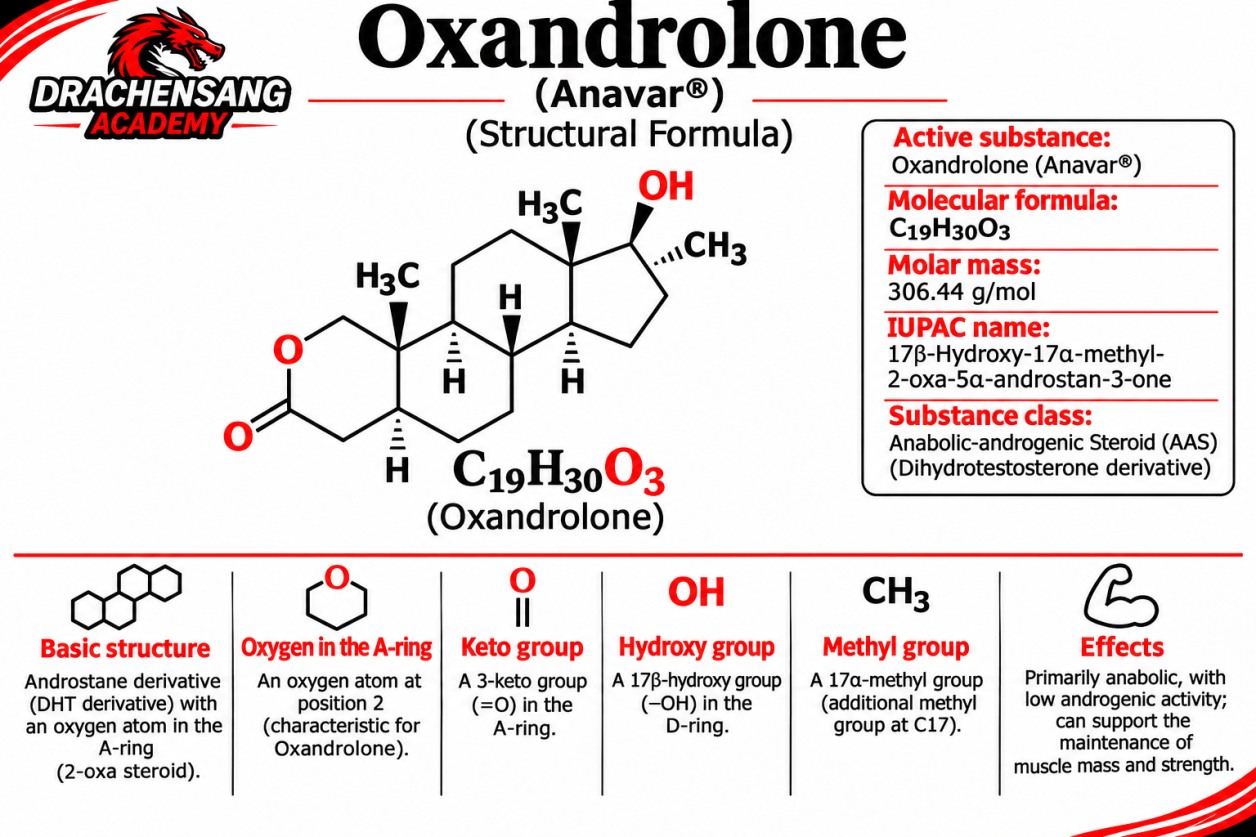
Oxandrolone belongs to the class of
anabolic-androgenic steroids
and is structurally related to
dihydrotestosterone (DHT).
Its molecular formula is
C19H30O3, and its molar mass
is approximately 306.44 g/mol.
A distinctive feature of oxandrolone
is the presence of an oxygen atom
within the steroid ring system,
making it a 2-oxa steroid.
Oxandrolone is also a
17-alpha-alkylated steroid,
a structural modification associated
with oral activity and important
liver-related safety considerations.
Like other anabolic-androgenic steroids,
oxandrolone interacts with androgen
receptors and can influence biological
processes involving protein metabolism,
muscle tissue, and other
androgen-responsive organs.
Oxandrolone is a pharmacologically
active steroid compound, not an
ordinary dietary supplement.
OXANDROLONE AND MUSCLE GROWTH
The association between oxandrolone
and muscle development is related
to its anabolic activity.
Androgen receptor signaling can
influence protein metabolism and
processes involved in maintaining
or developing lean body mass.
Clinical research has investigated
oxandrolone in selected medical
populations, including patients
experiencing significant weight
loss or catabolic conditions.
However, results from medically
defined patient groups cannot
automatically be applied to
healthy athletes or bodybuilders.
Medical treatment and athletic
performance enhancement are
not equivalent.
Oxandrolone is not a general
medical treatment for improving
athletic performance.
For sustainable muscle development,
resistance training, appropriate
nutrition, adequate recovery,
and consistent long-term training
remain fundamental.
WHY IS OXANDROLONE CONSIDERED A DISTINCTIVE ANABOLIC STEROID?
Oxandrolone is frequently described
as having a relatively favorable
anabolic-to-androgenic activity ratio
in certain experimental models.
This pharmacological characteristic
has contributed to its reputation
in fitness and bodybuilding discussions.
However, experimental activity ratios
do not reliably predict the complete
safety profile of a substance in humans.
Oxandrolone can still affect
the liver, blood lipid profile,
hormonal regulation, and
reproductive function.
A comparatively lower androgenic
profile in certain experimental
settings does not establish
overall clinical safety.
OXANDROLONE IS NOT AUTOMATICALLY "MILD"
Oxandrolone is sometimes
characterized as a "mild"
anabolic steroid.
From a medical perspective,
this informal description
can create a misleading
impression of safety.
The compound can produce
clinically important changes
in liver-related parameters
and lipid metabolism.
These may include reductions
in HDL cholesterol and
increases in LDL cholesterol.
Such changes can contribute
to an unfavorable
cardiovascular risk profile.
The absence of pronounced
fluid retention or certain
visible androgenic effects
does not demonstrate that
internal physiological
systems remain unaffected.
"Mild" should never be
interpreted as meaning
"safe" or "harmless."
POTENTIAL RISKS TO THE LIVER
Oxandrolone is an orally
active, 17-alpha-alkylated
anabolic-androgenic steroid.
This structural characteristic
contributes to oral activity
but is also associated with
important liver-related risks.
Potential concerns include:
• Changes in liver enzyme levels
• Cholestatic liver injury
• Jaundice
• Impaired bile flow
• Rare but serious hepatic complications
Long-term exposure to
androgenic anabolic steroids
has also been associated
with serious hepatic
conditions, including
peliosis hepatis and
certain liver tumors.
However, evidence from
the broader steroid class
should not automatically
be interpreted as proof
that every reported
complication occurs
at the same frequency
with oxandrolone.
Symptoms such as
unusual fatigue,
persistent nausea,
loss of appetite,
upper-right abdominal pain,
dark urine, or yellowing
of the skin or eyes
require prompt
medical evaluation.
Oral administration does
not eliminate the potential
for serious liver injury.
EFFECTS ON CHOLESTEROL AND THE CARDIOVASCULAR SYSTEM
In addition to liver-related
effects, lipid metabolism
is an important safety
consideration with oxandrolone.
The compound can adversely
affect the balance between
HDL and LDL cholesterol.
Potential changes include:
• Reduced HDL cholesterol
• Increased LDL cholesterol
• An unfavorable blood lipid profile
• Increased long-term cardiovascular risk
Research involving broader
anabolic steroid exposure
has also identified
associations with elevated
blood pressure, vascular
changes, and abnormalities
in cardiac structure
or function.
However, many of these
studies involve multiple
anabolic steroids, making
compound-specific conclusions
more difficult.
Changes in muscle size
or physical performance
do not reliably reflect
cardiovascular health.
OXANDROLONE IN WOMEN
Women may experience
androgen-related adverse
effects following exposure
to anabolic-androgenic
steroids.
Potential effects include:
• Acne and oily skin
• Increased facial or body hair
• Menstrual irregularities
• Deepening of the voice
• Changes in reproductive function
• Other signs of virilization
Some androgen-related
changes, particularly
voice deepening, may
be irreversible.
Oxandrolone should not
be used during pregnancy
because androgenic
substances can adversely
affect fetal development,
including the potential
virilization of a
female fetus.
Pregnancy-related risks
and potentially irreversible
androgenic effects require
particular attention.
POTENTIAL EFFECTS IN MEN
Men can also experience
adverse effects from
exogenous anabolic-androgenic
steroid exposure.
Potential concerns include:
• Suppression of natural testosterone production
• Changes in libido
• Reduced sperm production
• Impaired fertility
• Testicular dysfunction
• Acne and other androgen-related skin effects
These effects demonstrate
that the biological activity
of oxandrolone extends
beyond muscle tissue.
Individual outcomes vary
according to health status,
circumstances of exposure,
and other relevant factors.
OXANDROLONE AND NATURAL HORMONES
Anabolic-androgenic steroids
can interfere with the
body's natural endocrine
regulation.
Exogenous androgen exposure
may suppress the
hypothalamic-pituitary-gonadal
(HPG) axis.
This system regulates
important reproductive
hormones and natural
testosterone production.
Suppression of hormonal
signaling can contribute
to reduced endogenous
testosterone production
and impaired reproductive
function.
Recovery following
discontinuation can vary,
and prolonged hormonal
symptoms may occur
in some individuals.
Potential endocrine
effects should be considered
even when visible
androgenic changes
appear limited.
WHY BLOOD TESTS ARE IMPORTANT
When oxandrolone is used
for a legitimate medical
indication, appropriate
clinical and laboratory
monitoring is important.
Depending on the
individual circumstances,
healthcare professionals
may evaluate:
• Liver-related blood parameters
• HDL and LDL cholesterol
• Other relevant metabolic markers
• Hormonal and reproductive health
• Additional parameters based on clinical findings
Laboratory monitoring can
help identify changes
that may not produce
immediate symptoms.
However, normal test
results do not guarantee
the absence of all
potential adverse effects.
Medical monitoring supports
clinical decision-making;
it does not make nonmedical
steroid use risk-free.
OXANDROLONE IN BODYBUILDING: MEDICAL USE VS. MISUSE
Oxandrolone is frequently
discussed online in
connection with bodybuilding,
strength training, and
body composition.
Medical treatment and
nonmedical performance
enhancement are sometimes
presented as equivalent.
They are not.
Medical treatment is based
on a defined clinical
indication, professional
assessment, and
appropriate monitoring.
Nonmedical anabolic
steroid use for
performance enhancement
may involve significant
health risks without
an established medical
benefit for the individual.
OXANDROLONE AND ANTI-DOPING REGULATIONS
Oxandrolone is included
in the World Anti-Doping
Agency (WADA) Prohibited List
under S1 – Anabolic Agents.
It is prohibited both
in and out of competition
under applicable
anti-doping regulations.
Competitive athletes
should consult the
current WADA Prohibited
List and the rules of
their sports governing
organization.
OXANDROLONE: EFFECTS AND RISKS AT A GLANCE
Important considerations
regarding oxandrolone include:
• Synthetic anabolic-androgenic activity
• A history of therapeutic use
• Potential effects on lean body mass
• Possible liver-related adverse effects
• Changes in HDL and LDL cholesterol
• Potential cardiovascular health risks
• Suppression of natural hormonal regulation
• Possible impairment of fertility
• Risk of virilization in women
• Prohibited status under WADA regulations
These considerations
illustrate why oxandrolone
should be evaluated
beyond its reputation
in bodybuilding and
fitness communities.
IMPORTANT SAFETY INFORMATION
Drachensang Academy Global
provides this article
for general educational
and informational
purposes only.
Oxandrolone is a
pharmacologically active
anabolic-androgenic steroid
and is not an ordinary
dietary supplement.
Its medical history
does not establish
that nonmedical use
for performance enhancement
is safe.
Potential risks include
liver-related complications,
unfavorable blood lipid
changes, hormonal disruption,
and reproductive effects.
This article does not
recommend anabolic
steroid misuse or
provide dosage schedules,
cycles, or combination
instructions.
The information does
not replace professional
medical advice,
diagnosis, or treatment.
Anyone experiencing
health concerns related
to oxandrolone or other
anabolic steroids should
consult a qualified
healthcare professional.
CONCLUSION: OXANDROLONE IN CONTEXT
Oxandrolone is a
synthetic anabolic-androgenic
steroid with a history
of specific medical uses.
Historically marketed
under the names
Anavar and
Oxandrin,
it is also widely
recognized in bodybuilding
and strength-sport
communities.
Although oxandrolone
has anabolic properties,
its reputation as a
relatively "mild" steroid
should not be confused
with evidence of safety.
Potential concerns
include effects on
the liver, blood lipid
profile, cardiovascular
system, hormonal regulation,
and fertility.
Women may also experience
androgen-related changes,
some of which may
be irreversible.
Understanding oxandrolone
requires evaluating its
pharmacological properties,
medical history, potential
health risks, and
anti-doping relevance
as a whole.