SUSTANON: EFFECTS, COMPOSITION, MEDICAL USE & RISKS
Sustanon is an injectable, testosterone-based medicinal product historically used for testosterone replacement therapy (TRT) in men with medically confirmed testosterone deficiency.
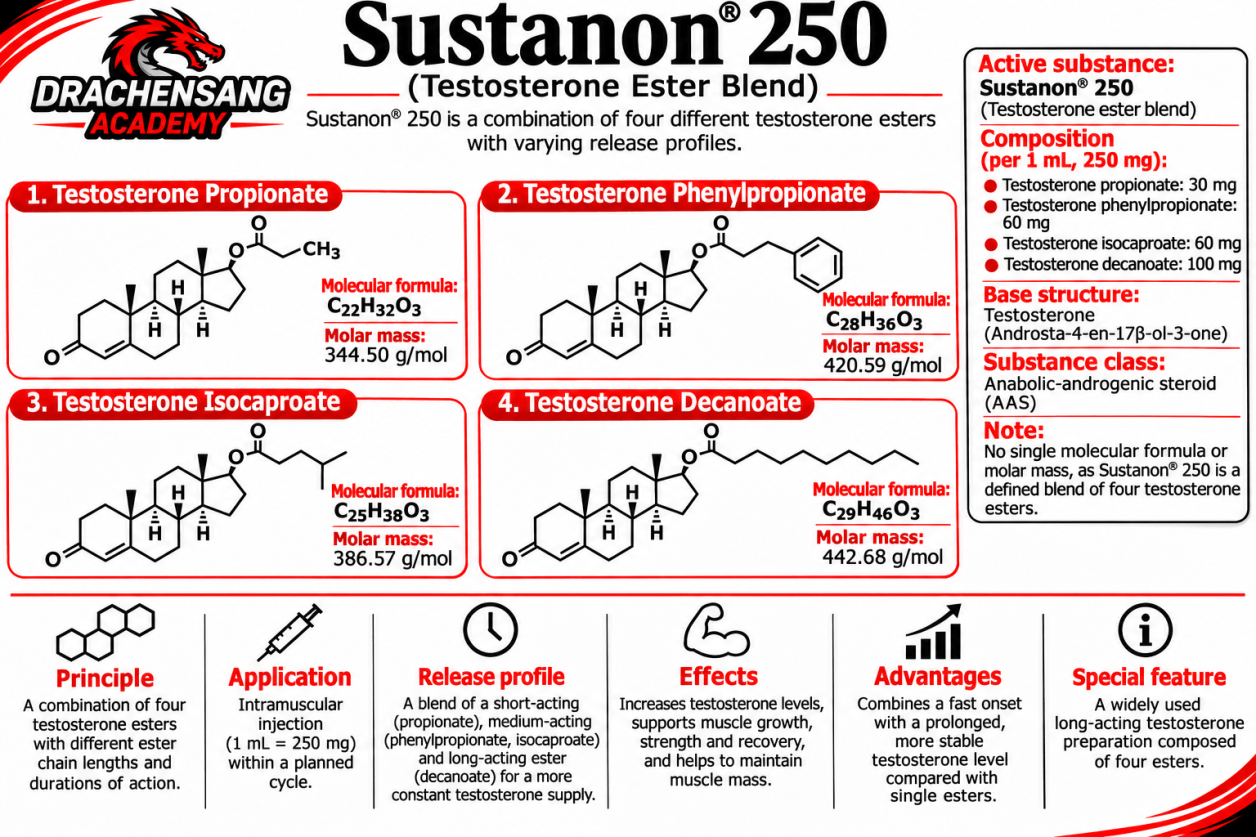
Unlike preparations containing a single testosterone ester, Sustanon 250 combines four different testosterone esters in one formulation.
Testosterone is an essential androgen involved in sexual development, reproductive function, muscle and bone metabolism, and numerous other physiological processes.
Because of its hormonal and anabolic effects, Sustanon is also widely discussed in bodybuilding, strength sports, and performance-enhancing drug use.
However, medically indicated testosterone replacement therapy must be clearly distinguished from nonmedical use intended to increase muscle mass or athletic performance.
WHAT IS SUSTANON?
Sustanon 250 is an injectable preparation containing four esterified forms of testosterone.
The traditional composition per 1 mL is:
• Testosterone Propionate – 30 mg
• Testosterone Phenylpropionate – 60 mg
• Testosterone Isocaproate – 60 mg
• Testosterone Decanoate – 100 mg
Together, these four components provide 250 mg of testosterone esters, equivalent to approximately 176 mg of testosterone after accounting for the ester groups.
The ester groups influence how testosterone is released from the injectable formulation.
Following administration, the esterified compounds are hydrolyzed, releasing testosterone.
The different esters contribute to the overall release characteristics of the preparation.
Sustanon does not have one unique molecular formula because it is a combination of four distinct testosterone ester compounds.
THE FOUR TESTOSTERONE ESTERS IN SUSTANON 250
Testosterone Propionate
Testosterone propionate is a relatively short-chain testosterone ester. Its ester structure contributes to comparatively rapid release characteristics following injection.
Testosterone Phenylpropionate
Testosterone phenylpropionate contains a phenylpropionate ester group and contributes to the formulation's overall release profile.
Testosterone Isocaproate
Testosterone isocaproate is another esterified testosterone compound included in the combination.
Testosterone Decanoate
Testosterone decanoate contains a longer ester chain and contributes to the more prolonged release characteristics of the preparation.
Although the four compounds differ in their ester structures, the biologically active hormone released after ester cleavage is testosterone.
These differences in formulation do not eliminate the potential adverse effects associated with testosterone exposure.
HOW DOES TESTOSTERONE WORK IN THE BODY?
Testosterone belongs to the group of androgenic hormones and plays an important role in the development and maintenance of male sexual characteristics.
It acts primarily through androgen receptor signaling and can also be converted into other biologically active hormones, including dihydrotestosterone (DHT) and estradiol.
Testosterone influences several physiological functions, including:
• Muscle and bone metabolism
• Protein metabolism
• Red blood cell production
• Libido and sexual function
• Body fat distribution
• Reproductive physiology
• Maintenance of secondary sexual characteristics
In men with clinically confirmed testosterone deficiency, appropriately prescribed testosterone replacement therapy may help improve symptoms associated with low testosterone levels.
However, treatment outcomes depend on the underlying medical condition and the individual's health status.
WHAT IS SUSTANON USED FOR MEDICALLY?
Sustanon has been used for testosterone replacement therapy in adult men with confirmed hypogonadism, where approved under applicable national regulations.
Hypogonadism is a condition in which the body produces insufficient testosterone because of a disorder affecting the testes, pituitary gland, or related hormonal regulation.
A diagnosis should not be based solely on symptoms such as fatigue, reduced libido, or decreased physical performance.
Clinical assessment generally involves a medical history, evaluation of symptoms, and appropriately timed laboratory measurements of testosterone.
Additional investigations may be necessary to determine the underlying cause.
The availability, approved indications, and regulatory status of Sustanon vary between countries.
Historical or international medical use does not mean that Sustanon 250 is approved or marketed in every country, including the United States.
SUSTANON AND MUSCLE BUILDING
Testosterone influences processes involved in muscle protein metabolism and the maintenance of lean body mass.
This anabolic activity is one reason testosterone preparations are frequently discussed in bodybuilding and strength training.
However, medically supervised testosterone replacement and nonmedical performance enhancement are fundamentally different situations.
The purpose of replacement therapy is to treat a diagnosed hormone deficiency, not to produce testosterone levels above the normal physiological range for athletic enhancement.
Nonmedical exposure to testosterone and other anabolic-androgenic steroids may involve significant cardiovascular, endocrine, reproductive, and psychological risks.
Sustanon is not a conventional muscle-building supplement.
For sustainable training progress, progressive resistance training, appropriate nutrition, adequate recovery, and sufficient sleep remain fundamental.
WHAT SIDE EFFECTS CAN SUSTANON CAUSE?
Like other testosterone-based medicines, Sustanon can cause adverse effects.
Potential or documented effects of testosterone treatment include:
• Increased hemoglobin and hematocrit
• Increased red blood cell production
• Acne and oily skin
• Fluid retention
• Weight changes
• Changes in libido
• Gynecomastia
• Changes in blood pressure
• Changes in blood lipid levels
• Suppression of sperm production
• Prostate-related changes
• Injection-site reactions
The likelihood and severity of adverse effects depend on individual factors, the clinical circumstances, and the degree of testosterone exposure.
An increase in hematocrit is particularly important because excessive red blood cell production can require medical intervention.
The potential for adverse effects should be considered even when testosterone is prescribed for a legitimate medical indication.
SUSTANON AND RED BLOOD CELL PRODUCTION
Testosterone can stimulate the production of red blood cells, a process known as erythropoiesis.
This effect can increase hemoglobin and hematocrit levels.
Although red blood cell production is a normal physiological process, excessive increases in hematocrit can become a clinical concern.
For this reason, healthcare professionals generally monitor relevant blood parameters during testosterone replacement therapy.
Changes in hematocrit may occur without obvious symptoms, making appropriate laboratory monitoring important.
SUSTANON AND CARDIOVASCULAR HEALTH
Cardiovascular health is an important consideration during testosterone treatment.
Testosterone preparations can influence blood pressure, fluid balance, and certain blood parameters.
Research into cardiovascular outcomes during medically indicated testosterone replacement therapy has produced findings that depend on the patient population, treatment conditions, and outcomes being studied.
Evidence from medically supervised replacement therapy should not be directly applied to nonmedical anabolic steroid use, which may involve substantially different exposure patterns.
Research involving nonmedical anabolic-androgenic steroid use has identified associations with cardiovascular complications, including changes in cardiac structure and function.
Medical testosterone replacement therapy and nonmedical high-exposure steroid use must therefore be evaluated separately.
SUSTANON AND FERTILITY
An important consideration with exogenous testosterone is its potential effect on male fertility.
Testosterone introduced from outside the body can suppress the hypothalamic-pituitary-gonadal (HPG) axis.
This may reduce the production of luteinizing hormone (LH) and follicle-stimulating hormone (FSH), which are important for normal testicular function and sperm production.
As a result, exogenous testosterone can reduce sperm production and may cause severe oligospermia or azoospermia.
Recovery after discontinuation varies and may take considerable time.
Men who wish to preserve fertility or are planning to have children should discuss these concerns with an appropriately qualified healthcare professional before beginning testosterone therapy.
Testosterone replacement therapy should not be assumed to preserve normal sperm production.
SUSTANON AND PROSTATE HEALTH
Prostate health is another consideration in the medical evaluation of testosterone treatment.
Testosterone can influence androgen-responsive prostate tissue.
Depending on age, medical history, symptoms, and individual risk factors, healthcare professionals may assess prostate health before and during treatment.
This may include clinical evaluation and prostate-specific antigen (PSA) testing when appropriate.
A rise in PSA does not automatically indicate prostate cancer, but clinically significant changes require professional assessment.
Testosterone therapy is not appropriate in certain circumstances, including some known or suspected androgen-sensitive cancers.
Prostate-related monitoring should be individualized rather than treated as identical for every patient.
WHAT MONITORING IS IMPORTANT DURING SUSTANON TREATMENT?
Medically indicated testosterone replacement therapy requires appropriate clinical follow-up.
Depending on the patient's circumstances, monitoring may include:
• Testosterone concentrations
• Hemoglobin and hematocrit
• Blood pressure
• Treatment response and adverse effects
• PSA and prostate assessment when indicated
• Blood lipid levels when clinically relevant
• Other laboratory parameters based on medical history
The timing and interpretation of testosterone measurements can depend on the formulation and clinical circumstances.
Liver function testing may also be appropriate in selected patients, although it is not a universal requirement specific to every injectable testosterone regimen.
Medical monitoring helps identify potential complications and assess whether treatment remains appropriate.
However, monitoring does not guarantee that every adverse effect can be prevented.
SUSTANON IN WOMEN
Sustanon is a testosterone preparation intended for specific medical indications and should not be regarded as a general treatment for women.
Exposure to testosterone can cause androgen-related effects, including:
• Acne and oily skin
• Increased facial or body hair
• Menstrual irregularities
• Deepening of the voice
• Other signs of virilization
Some changes, particularly voice deepening, may be irreversible.
Testosterone exposure during pregnancy may adversely affect fetal development, including the risk of virilization of a female fetus.
Sustanon should not be used during pregnancy.
WHY SUSTANON IS NOT COMPARABLE TO DIETARY SUPPLEMENTS
Sustanon is sometimes discussed alongside products associated with muscle development, strength, and bodybuilding.
However, it is fundamentally different from ordinary nutritional supplements.
Sustanon is a hormonally active medicinal product containing testosterone esters.
Its biological effects can influence the endocrine system, reproductive function, blood parameters, and other physiological processes.
Conventional supplements such as protein powders or creatine do not contain testosterone and do not act as testosterone replacement medicines.
The potential benefits and risks of Sustanon must therefore be evaluated in a medical and pharmacological context.
SUSTANON AND ANTI-DOPING REGULATIONS
Testosterone is included in the World Anti-Doping Agency (WADA) Prohibited List under S1 – Anabolic Agents.
It is prohibited both in and out of competition under applicable anti-doping rules.
Athletes receiving medically indicated testosterone treatment should consult the relevant anti-doping regulations and therapeutic use exemption requirements.
A medical prescription does not automatically establish permission to use a prohibited substance in competitive sports.
SUSTANON: KEY FACTS AT A GLANCE
Important considerations regarding Sustanon 250 include:
• Injectable combination of four testosterone esters
• Total ester content of 250 mg per 1 mL
• Equivalent to approximately 176 mg of testosterone
• Historical and current medical use varies by country
• Intended for treatment of confirmed testosterone deficiency where approved
• Potential effects on muscle and bone metabolism
• Possible increases in hemoglobin and hematocrit
• Potential blood pressure and fluid balance changes
• Suppression of natural reproductive hormone signaling
• Possible reduction or cessation of sperm production
• Need for individualized medical monitoring
• Prohibited status under WADA regulations
These characteristics demonstrate why Sustanon should be considered a pharmaceutical testosterone preparation rather than a general fitness product.
IMPORTANT SAFETY INFORMATION
Drachensang Academy Global provides this article for general educational and informational purposes only.
Sustanon is a hormonally active medicinal product, not a dietary supplement.
Where legally available, it should be used only in accordance with applicable prescribing requirements and professional medical supervision.
Nonmedical testosterone use for muscle development or performance enhancement may involve significant health risks.
This article does not provide dosage schedules, injection instructions, steroid cycles, or combination recommendations.
The information does not replace professional medical advice, diagnosis, or treatment.
Anyone considering testosterone treatment or experiencing possible adverse effects should consult a qualified healthcare professional or pharmacist.
CONCLUSION: SUSTANON IN CONTEXT
Sustanon 250 is an injectable testosterone preparation combining four testosterone esters with different release characteristics.
Its medical role is primarily associated with testosterone replacement therapy in men with confirmed testosterone deficiency, subject to national approval and prescribing requirements.
Testosterone is essential for numerous physiological functions, including sexual health, muscle and bone metabolism, and red blood cell production.
When testosterone replacement is medically indicated, treatment may provide clinical benefits.
At the same time, potential adverse effects involving hematocrit, blood pressure, reproductive function, prostate health, and other physiological systems require consideration.
Nonmedical use for bodybuilding or performance enhancement should not be confused with medically supervised hormone replacement therapy.
Understanding Sustanon requires considering its four-ester composition, medical indications, hormonal effects, potential health risks, and anti-doping status as a whole.