TESTOSTERONE ACETATE: EFFECTS, PROPERTIES & POTENTIAL RISKS
Testosterone Acetate is an esterified derivative of testosterone, the primary male sex hormone and an important member of the androgen family.
The addition of an acetate ester group changes the compound's chemical structure and can influence its pharmacokinetic properties.
Testosterone itself contributes to the development and maintenance of male sexual characteristics and plays important roles in muscle tissue, bone metabolism, sexual function, and red blood cell production.
However, the biological functions of naturally occurring testosterone must be distinguished from the effects and potential risks of administering testosterone-based compounds.
WHAT IS TESTOSTERONE ACETATE?
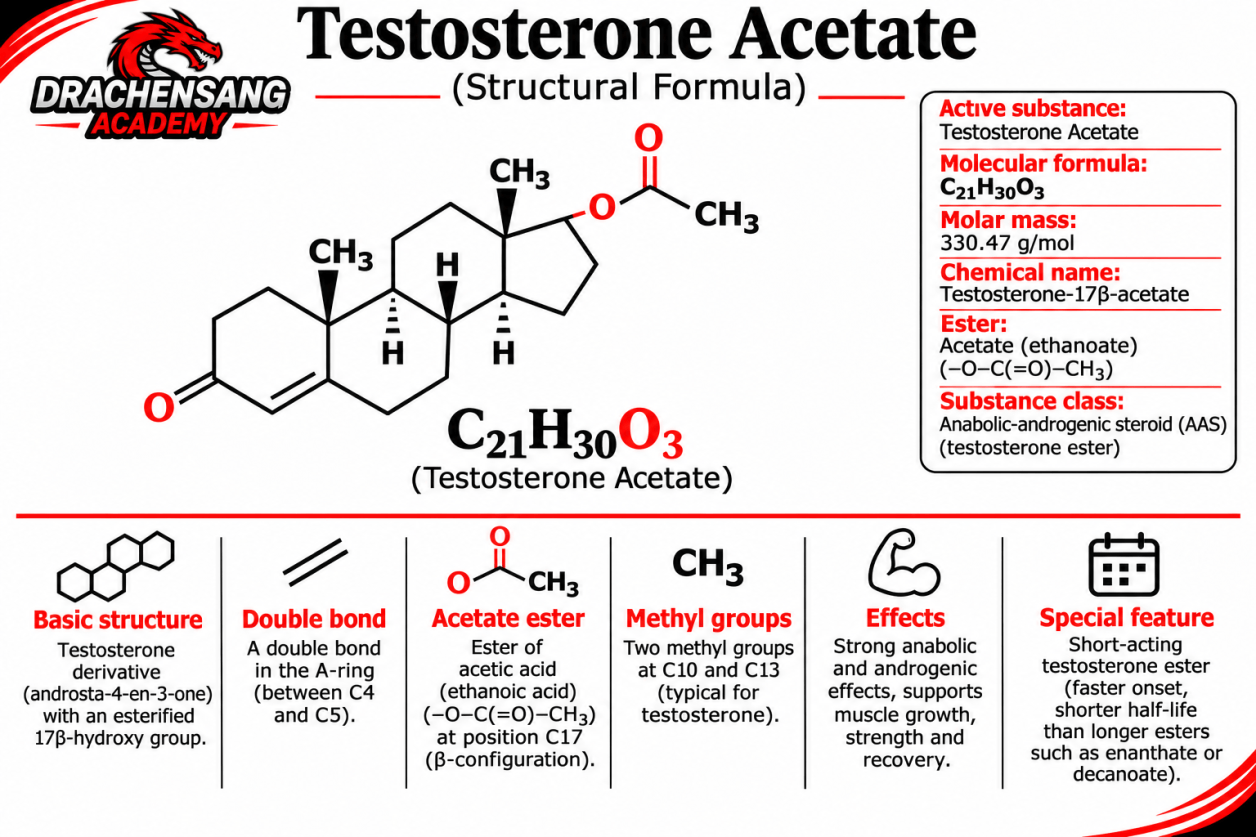
Testosterone acetate is a testosterone ester formed by attaching an acetate group to the hydroxyl group at the 17-beta position of testosterone.
Its molecular formula is C21H30O3, and its molar mass is approximately 330.47 g/mol.
The acetate ester changes the chemical properties of the molecule without creating an entirely new type of androgenic hormone.
Following enzymatic hydrolysis, testosterone can be released from the esterified compound.
The released testosterone acts through the androgen receptor and can also undergo metabolism into other biologically active hormones.
These include dihydrotestosterone (DHT), formed through 5-alpha-reductase activity, and estradiol, formed through aromatase activity.
Both pathways contribute to the physiological effects associated with testosterone.
Testosterone acetate is chemically distinct from unesterified testosterone, but its principal androgenic activity is associated with the testosterone released after ester cleavage.
TESTOSTERONE AND MUSCLE DEVELOPMENT
Testosterone contributes to biological processes involved in muscle mass, protein metabolism, strength, and physical development.
Androgen receptor signaling influences muscle tissue and other androgen-responsive organs.
These physiological properties explain why testosterone-based compounds are frequently discussed in bodybuilding and strength-training communities.
However, evidence demonstrating the anabolic effects of testosterone in general should not automatically be presented as compound-specific clinical evidence for testosterone acetate.
Published human clinical evidence specifically evaluating testosterone acetate is limited compared with more widely studied testosterone formulations.
Furthermore, the normal physiological role of testosterone does not mean that additional exposure is automatically medically appropriate or safe.
Medical indications, individual health status, and appropriate professional supervision remain essential considerations.
HOW DO TESTOSTERONE ESTERS DIFFER?
Testosterone can be chemically modified by attaching different ester groups to its molecular structure.
Examples include:
• Testosterone Acetate
• Testosterone Propionate
• Testosterone Enanthate
• Testosterone Cypionate
• Testosterone Undecanoate
These compounds share the same underlying testosterone structure but differ in the chemical composition of their ester groups.
Esterification can influence properties such as solubility, absorption, release characteristics, and the duration of exposure following administration.
However, the actual pharmacokinetic behavior also depends on the formulation and route of administration.
Therefore, an ester structure alone is not sufficient to establish a precise duration of action in humans.
Testosterone acetate should not be considered automatically interchangeable with testosterone propionate, enanthate, or other testosterone esters.
TESTOSTERONE ACETATE AND MEDICAL USE
Testosterone-based medicines are used in certain medical settings, particularly for the treatment of clinically confirmed testosterone deficiency.
However, regulatory approval applies to specific pharmaceutical products and formulations rather than to every chemically possible testosterone ester.
Testosterone acetate should therefore not be assumed to have the same approved indications, clinical evidence, or availability as established testosterone replacement preparations.
In the United States, medically prescribed testosterone replacement therapy generally involves specifically approved testosterone formulations.
The medical use of testosterone as a hormone does not establish that testosterone acetate itself is an FDA-approved replacement therapy.
WHAT POTENTIAL RISKS ARE ASSOCIATED WITH TESTOSTERONE?
Testosterone is a pharmacologically active hormone that can influence multiple physiological systems.
Potential adverse effects associated with exogenous testosterone exposure include:
• Acne and increased skin oiliness
• Changes in body hair
• Changes in libido
• Fluid retention
• Increased hemoglobin and hematocrit
• Suppression of natural testosterone production
• Reduced sperm production
• Potential impairment of fertility
• Gynecomastia
• Changes in blood pressure
• Changes in prostate-related parameters
The likelihood and severity of these effects depend on the individual's health status, the degree of hormonal exposure, and other relevant circumstances.
One clinically important concern is erythrocytosis, an excessive increase in red blood cell concentration.
Testosterone exposure can also suppress reproductive hormone signaling and reduce sperm production.
These risks are documented primarily through research and clinical experience involving testosterone preparations generally.
They should not be interpreted as a complete, independently established adverse-effect profile specific to testosterone acetate.
TESTOSTERONE ACETATE AND NATURAL HORMONE PRODUCTION
Exogenous testosterone can interfere with the body's natural endocrine regulation.
Normal testosterone production is controlled through the hypothalamic-pituitary-gonadal (HPG) axis.
This hormonal feedback system involves the hypothalamus, pituitary gland, and testes.
When testosterone is introduced from outside the body, negative feedback can suppress the release of gonadotropins, including luteinizing hormone (LH) and follicle-stimulating hormone (FSH).
This suppression can reduce natural testosterone production and impair normal sperm production.
Potential consequences include:
• Reduced endogenous testosterone production
• Changes in testicular function
• Reduced sperm production
• Fertility problems
• Changes in sexual function
• Hormonal symptoms following discontinuation
Recovery after discontinuation varies between individuals and may take considerable time.
Men who wish to preserve fertility or are planning to have children should discuss testosterone-related treatment with an appropriately qualified healthcare professional.
TESTOSTERONE AND CARDIOVASCULAR HEALTH
Cardiovascular health is an important consideration when evaluating exogenous testosterone exposure.
Testosterone preparations can influence blood pressure, fluid balance, hematocrit, and other physiological parameters.
Research on cardiovascular outcomes during medically supervised testosterone replacement therapy must be distinguished from studies involving nonmedical anabolic-androgenic steroid use.
These situations may involve different populations, exposure patterns, and health risks.
Research involving nonmedical anabolic steroid use has identified associations with cardiovascular complications, including changes in cardiac structure and function.
However, findings involving multiple anabolic steroids cannot automatically be attributed specifically to testosterone acetate.
Cardiovascular risk assessment requires consideration of the actual exposure, underlying health conditions, and available clinical evidence.
IS TESTOSTERONE ACETATE A DIETARY SUPPLEMENT?
No. Testosterone acetate is not an ordinary dietary supplement.
It is a chemically defined, hormonally active testosterone derivative.
Testosterone and its esters must be distinguished from conventional sports nutrition products such as protein supplements or creatine.
These nutritional products do not contain testosterone and do not function as testosterone replacement medicines.
In bodybuilding and fitness discussions, it is important to distinguish between dietary supplements, approved prescription medicines, and nonmedical anabolic-androgenic steroid use.
TESTOSTERONE ACETATE IN BODYBUILDING
Testosterone is frequently discussed in bodybuilding because of its relationship to muscle development, strength, and androgenic activity.
Testosterone acetate may appear in discussions of different testosterone ester compounds.
However, claims about exceptional muscle-building effects, rapid results, or specific performance advantages require reliable compound-specific evidence.
A stronger hormonal effect does not necessarily correspond to a safer or more sustainable outcome.
Hormonal changes can also produce adverse effects that are not immediately visible.
For sustainable physical development, progressive resistance training, adequate nutrition, sufficient protein intake, quality sleep, and appropriate recovery remain important.
Nonmedical testosterone use should not be confused with medically supervised hormone replacement therapy.
TESTOSTERONE ACETATE AND ANTI-DOPING REGULATIONS
Testosterone and its esters fall within the scope of the World Anti-Doping Agency (WADA) Prohibited List under S1 – Anabolic Agents.
Their use is prohibited both in and out of competition under applicable anti-doping rules.
Athletes receiving medically indicated testosterone treatment should consult the relevant anti-doping regulations and therapeutic use exemption requirements.
A medical prescription does not automatically establish permission to use a prohibited substance in competitive sports.
WHY IS MEDICAL MONITORING IMPORTANT?
When testosterone replacement therapy is medically indicated, appropriate clinical monitoring is essential.
Depending on the patient's medical history and prescribed formulation, follow-up may include:
• Testosterone concentrations
• Complete blood count
• Hemoglobin and hematocrit
• Blood pressure
• Treatment response and adverse effects
• Prostate assessment when indicated
• Other relevant laboratory parameters
Regular medical assessment can help identify treatment-related changes that may occur without obvious symptoms.
However, monitoring does not guarantee that every potential adverse effect can be prevented.
These monitoring principles primarily concern established testosterone therapies and should not be interpreted as evidence that testosterone acetate is an approved or clinically validated treatment.
TESTOSTERONE ACETATE: KEY FACTS AT A GLANCE
Important considerations regarding testosterone acetate include:
• Esterified derivative of testosterone
• Molecular formula: C21H30O3
• Molar mass: approximately 330.47 g/mol
• Acetate ester attached at the 17-beta position
• Potential release of testosterone following ester hydrolysis
• Pharmacologically distinct from other testosterone ester formulations
• Limited compound-specific human clinical evidence
• Potential hormonal and reproductive risks associated with testosterone exposure
• Possible effects on hematocrit and cardiovascular health
• Relevance to anti-doping regulations
These characteristics illustrate why testosterone acetate should be evaluated as a specific chemical compound rather than simply treated as interchangeable with every other testosterone preparation.
IMPORTANT SAFETY INFORMATION
Drachensang Academy Global provides this article exclusively for general educational and informational purposes.
Testosterone acetate is a pharmacologically active testosterone derivative and is not a dietary supplement.
Nonmedical use of testosterone or other anabolic-androgenic steroids can involve significant hormonal, cardiovascular, and reproductive health risks.
This article does not provide dosage schedules, injection instructions, steroid cycles, or combination recommendations.
The information does not replace professional medical advice, diagnosis, or treatment.
Anyone considering medically indicated testosterone treatment or experiencing possible adverse effects should consult a qualified healthcare professional.
CONCLUSION: TESTOSTERONE ACETATE EXPLAINED
Testosterone acetate is an esterified form of testosterone belonging to the androgen class.
Its acetate group distinguishes the molecule chemically from other testosterone esters and can influence its pharmacokinetic characteristics.
Following ester cleavage, testosterone becomes available to participate in androgen-dependent physiological processes.
The compound is relevant to discussions involving hormonal activity, muscle development, bodybuilding, and anti-doping regulations.
However, the established biological effects of testosterone should not automatically be interpreted as evidence of specific clinical benefits or approved medical applications for testosterone acetate.
Potential concerns associated with exogenous testosterone exposure include suppression of natural hormone production, impaired fertility, increased hematocrit, blood pressure changes, and other adverse effects.
Understanding testosterone acetate requires distinguishing its chemical properties from the broader medical evidence concerning testosterone and its approved pharmaceutical formulations.