TESTOSTERONE DEPOT: EFFECTS, MEDICAL USE, RISKS & IMPORTANT INFORMATION
Testosterone Depot is a general term for longer-acting testosterone preparations designed to release the hormone gradually over an extended period.
These formulations may be used in testosterone replacement therapy (TRT) for men with medically confirmed testosterone deficiency, depending on the specific product and applicable national approvals.
Testosterone is a naturally occurring androgen involved in sexual development, reproductive function, bone health, muscle metabolism, and red blood cell production.
However, a single low testosterone measurement does not automatically establish the need for treatment.
A proper diagnosis generally requires compatible clinical findings, consistently low testosterone concentrations, and appropriate medical evaluation.
WHAT IS TESTOSTERONE DEPOT?
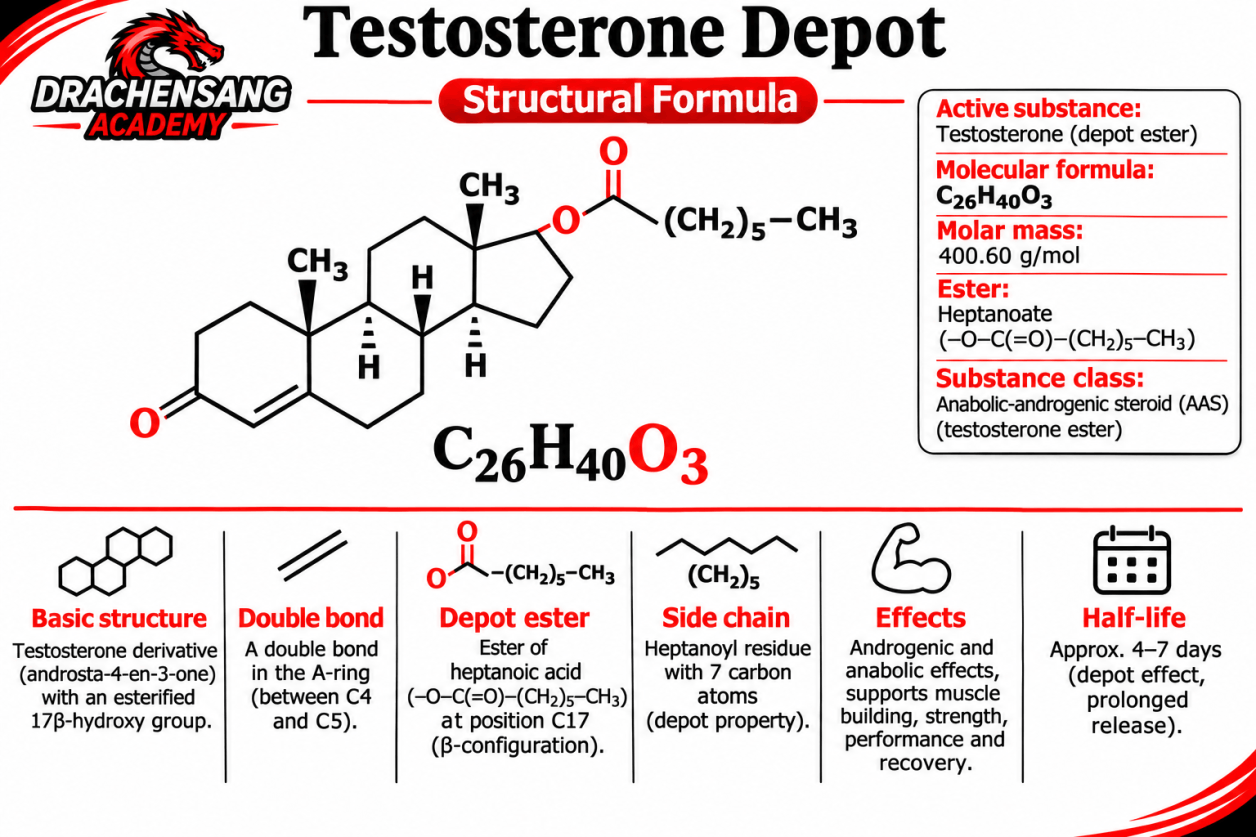
The term Testosterone Depot does not identify one specific chemical compound.
Instead, it describes pharmaceutical formulations intended to provide prolonged testosterone exposure.
Many injectable depot preparations contain esterified testosterone compounds.
Examples include:
• Testosterone Enanthate
• Testosterone Cypionate
• Testosterone Undecanoate
These compounds share the underlying testosterone structure but contain different ester groups.
The ester structure, pharmaceutical formulation, and route of administration influence absorption and release characteristics.
Following enzymatic hydrolysis of the ester, biologically active testosterone becomes available.
Testosterone Depot does not have one universal molecular formula because the term can refer to different testosterone esters and formulations.
HOW DO TESTOSTERONE DEPOT PREPARATIONS DIFFER?
Longer-acting testosterone preparations are not necessarily interchangeable.
Their pharmacokinetic properties depend on the ester and the specific pharmaceutical formulation.
Testosterone Enanthate
Testosterone enanthate is an esterified testosterone compound used in certain injectable testosterone preparations.
Testosterone Cypionate
Testosterone cypionate is another esterified form of testosterone used in medically prescribed replacement therapy where approved.
Testosterone Undecanoate
Injectable testosterone undecanoate is used in certain longer-acting depot formulations.
Some testosterone undecanoate products require special precautions because rare but serious reactions can occur during or shortly after administration.
The actual duration of action depends on the specific product and cannot be determined solely from the ester name.
Differences in release characteristics do not mean that one preparation is automatically safer than another.
HOW DOES TESTOSTERONE WORK IN THE BODY?
Testosterone belongs to the class of androgenic steroid hormones.
In men, most endogenous testosterone is produced in the testes under the control of the hypothalamus and pituitary gland.
Testosterone acts through androgen receptor signaling and can also be converted into other biologically active hormones.
These include dihydrotestosterone (DHT) and estradiol.
Testosterone contributes to several physiological functions:
• Development and maintenance of male sexual characteristics
• Sexual desire and sexual function
• Muscle and protein metabolism
• Bone metabolism and bone health
• Red blood cell production
• Body composition and fat distribution
• Other androgen-dependent processes
In men with clinically confirmed hypogonadism, appropriately prescribed testosterone replacement therapy may improve certain symptoms associated with hormone deficiency.
Treatment response varies according to the underlying medical condition and individual circumstances.
HOW IS TESTOSTERONE DEFICIENCY DIAGNOSED?
Testosterone deficiency should not be diagnosed based solely on symptoms such as fatigue, reduced libido, decreased physical performance, or changes in body composition.
These symptoms can have many different causes.
A reliable diagnosis generally requires compatible clinical symptoms or signs together with consistently low testosterone concentrations.
Testosterone measurements are commonly obtained in the morning because hormone concentrations can fluctuate throughout the day.
Repeat measurements are generally necessary to confirm an initially low result.
Additional testing may include luteinizing hormone (LH), follicle-stimulating hormone (FSH), and other laboratory parameters when clinically indicated.
Potential contributing factors include:
• Disorders affecting the testes
• Pituitary or hypothalamic conditions
• Certain medications
• Obesity and metabolic conditions
• Acute or chronic illness
• Other endocrine disorders
A laboratory result must be interpreted in the context of the patient's symptoms, medical history, and overall health.
TESTOSTERONE DEPOT AND MUSCLE GROWTH
Testosterone influences processes involved in muscle protein metabolism, lean body mass, and strength.
These physiological effects explain why testosterone preparations are frequently discussed in bodybuilding and strength-training communities.
However, medically indicated testosterone replacement therapy must be distinguished from nonmedical use for physique or performance enhancement.
The purpose of replacement therapy is to address a diagnosed hormone deficiency, not to deliberately raise testosterone concentrations above the normal physiological range for athletic performance.
Nonmedical testosterone use can involve significant endocrine, reproductive, cardiovascular, and other health risks.
For sustainable muscle development, progressive resistance training, appropriate nutrition, adequate protein intake, sufficient sleep, and recovery remain fundamental.
Testosterone replacement therapy is a medical treatment, not a general muscle-building strategy for healthy individuals.
WHAT SIDE EFFECTS CAN TESTOSTERONE CAUSE?
Testosterone-based medicines can produce adverse effects, even when prescribed for a legitimate medical indication.
Potential effects include:
• Increased hemoglobin and hematocrit
• Increased red blood cell production
• Acne and increased skin oiliness
• Fluid retention
• Changes in blood pressure
• Changes in libido
• Gynecomastia
• Reduced sperm production
• Impaired fertility
• Possible worsening of existing sleep apnea
• Prostate-related changes
• Injection-site reactions
The likelihood and severity of these effects vary according to the patient's health status, the specific preparation, and the circumstances of treatment.
An increase in hemoglobin and hematocrit is particularly important because excessive red blood cell production can require medical intervention.
The possibility of adverse effects should be considered during both treatment planning and follow-up.
TESTOSTERONE AND RED BLOOD CELL PRODUCTION
Testosterone can stimulate erythropoiesis, the process through which the body produces red blood cells.
This can increase hemoglobin and hematocrit levels.
An excessive rise in hematocrit is referred to as erythrocytosis and may require treatment adjustment or further medical evaluation.
Because these changes can develop without obvious symptoms, laboratory monitoring is an important component of medically supervised testosterone replacement therapy.
Normal physical performance does not guarantee that blood parameters remain within a healthy range.
TESTOSTERONE AND CARDIOVASCULAR HEALTH
Cardiovascular health is an important consideration during testosterone treatment.
Testosterone preparations can influence blood pressure, fluid balance, and hematocrit.
Research examining cardiovascular outcomes during medically supervised testosterone replacement therapy has produced findings that depend on the population studied, the treatment conditions, and the outcomes evaluated.
These findings should not be directly applied to nonmedical anabolic-androgenic steroid use, which may involve different exposure patterns.
Studies involving nonmedical anabolic steroid use have identified associations with cardiovascular complications, including changes in cardiac structure and function.
Cardiovascular risks should be evaluated according to the patient's health status and the actual circumstances of testosterone exposure.
TESTOSTERONE AND FERTILITY
Fertility is an important consideration when testosterone is administered from outside the body.
Exogenous testosterone can suppress the hypothalamic-pituitary-gonadal (HPG) axis.
This may reduce the release of luteinizing hormone (LH) and follicle-stimulating hormone (FSH).
These hormones are important for normal testicular function and sperm production.
As a result, testosterone treatment can substantially reduce sperm production and may cause severe oligospermia or azoospermia.
Recovery after discontinuation varies between individuals and may take considerable time.
Men who wish to preserve fertility or are planning to have children should discuss these concerns with a qualified healthcare professional before beginning testosterone treatment.
Testosterone replacement therapy should not be assumed to preserve normal fertility.
WHY IS REGULAR MEDICAL MONITORING IMPORTANT?
Testosterone replacement therapy requires appropriate clinical follow-up.
Depending on the patient's age, medical history, treatment formulation, and individual risk factors, monitoring may include:
• Testosterone concentrations
• Hemoglobin and hematocrit
• Complete blood count
• Blood pressure
• Treatment response and adverse effects
• PSA and prostate assessment when indicated
• Other relevant laboratory parameters
The timing of testosterone measurements may differ between formulations because release characteristics are not identical.
Regular medical evaluation helps determine whether treatment is achieving its intended purpose and whether adverse effects are developing.
However, monitoring does not guarantee that every potential complication can be prevented.
TESTOSTERONE DEPOT AND PROSTATE HEALTH
Testosterone can influence androgen-responsive prostate tissue.
Depending on the patient's age, medical history, symptoms, and individual risk factors, prostate-related assessment may be appropriate before and during treatment.
This may include prostate-specific antigen (PSA) testing and other clinical evaluations when indicated.
A change in PSA does not automatically establish the presence of prostate cancer, but clinically significant changes require professional assessment.
Certain known or suspected androgen-sensitive cancers may be contraindications to testosterone treatment.
Prostate-related monitoring should be individualized rather than assumed to be identical for every patient.
TESTOSTERONE DEPOT IS NOT A HARMLESS FITNESS PRODUCT
The term "Depot" describes prolonged release characteristics rather than a special form of testosterone without health risks.
Longer-lasting hormone exposure does not automatically mean greater safety.
Testosterone is a pharmacologically active hormone that can influence endocrine regulation, reproductive function, blood parameters, and cardiovascular health.
Some depot formulations also have product-specific precautions.
For example, certain injectable testosterone undecanoate preparations have been associated with rare but serious reactions, including pulmonary oil microembolism (POME) and anaphylactic reactions.
These precautions depend on the particular product and should not automatically be attributed to every testosterone depot formulation.
Medical supervision and product-specific prescribing information remain essential.
TESTOSTERONE DEPOT AND ANTI-DOPING REGULATIONS
Testosterone and its esters are included within the scope of the World Anti-Doping Agency (WADA) Prohibited List under S1 – Anabolic Agents.
Their use is prohibited both in and out of competition under applicable anti-doping rules.
Athletes receiving medically indicated testosterone treatment should consult the current anti-doping regulations and relevant therapeutic use exemption requirements.
A medical prescription does not automatically provide permission to use a prohibited substance in competitive sports.
TESTOSTERONE DEPOT: KEY FACTS AT A GLANCE
Important considerations regarding Testosterone Depot include:
• General term for longer-acting testosterone preparations
• Not one specific chemical compound
• May contain testosterone enanthate, cypionate, or undecanoate
• Formulation-dependent release characteristics
• Medical use for confirmed testosterone deficiency where approved
• Potential benefits in appropriately selected patients
• Possible increases in hemoglobin and hematocrit
• Potential effects on blood pressure and fluid balance
• Suppression of natural reproductive hormone signaling
• Possible impairment of sperm production and fertility
• Need for individualized medical monitoring
• Prohibited status under WADA regulations
These considerations demonstrate why testosterone depot preparations must be evaluated as pharmaceutical hormone treatments rather than ordinary fitness products.
IMPORTANT SAFETY INFORMATION
Drachensang Academy Global provides this article exclusively for general educational and informational purposes.
Testosterone depot preparations are pharmacologically active hormonal medicines, not dietary supplements.
Where legally available, testosterone replacement therapy should be based on an appropriate medical indication and conducted under qualified professional supervision.
Nonmedical testosterone use for bodybuilding or performance enhancement can involve significant endocrine, cardiovascular, and reproductive health risks.
This article does not provide dosage schedules, injection instructions, steroid cycles, or combination recommendations.
The information does not replace professional medical advice, diagnosis, or treatment.
Anyone considering testosterone treatment or experiencing possible adverse effects should consult a qualified healthcare professional.
TESTOSTERONE DEPOT: CONCLUSION
Testosterone Depot is a general term for longer-acting testosterone preparations that may be used in medically supervised hormone replacement therapy for men with confirmed testosterone deficiency.
The specific pharmacokinetic characteristics depend on the testosterone ester, pharmaceutical formulation, and route of administration.
A reliable diagnosis, appropriate laboratory testing, and ongoing medical monitoring are important components of responsible testosterone treatment.
Although testosterone plays an essential role in muscle and bone metabolism, medically indicated replacement therapy must be distinguished from nonmedical use for performance enhancement.
Potential concerns include increased hematocrit, blood pressure changes, suppression of sperm production, impaired fertility, and other hormonal effects.
Understanding Testosterone Depot requires considering the specific formulation, medical indication, individual health status, and potential risks rather than viewing prolonged hormone release as a guarantee of safety.