Trenbolone Enanthate: Effects, Properties and Risks
Trenbolone Enanthate is an esterified derivative of trenbolone, a synthetic anabolic-androgenic steroid (AAS).
The compound is frequently discussed in bodybuilding and performance-oriented strength training because of trenbolone's anabolic activity and its perceived effects on muscle mass, strength, and body composition.
However, trenbolone enanthate is not approved for human medical use in the United States, and its potential health consequences have not been adequately characterized through controlled human clinical studies.
This article from Drachensang Academy Global examines the compound's chemical properties, biological activity, and potential risks from an educational and scientific perspective.
WHAT IS TRENBOLONE ENANTHATE?
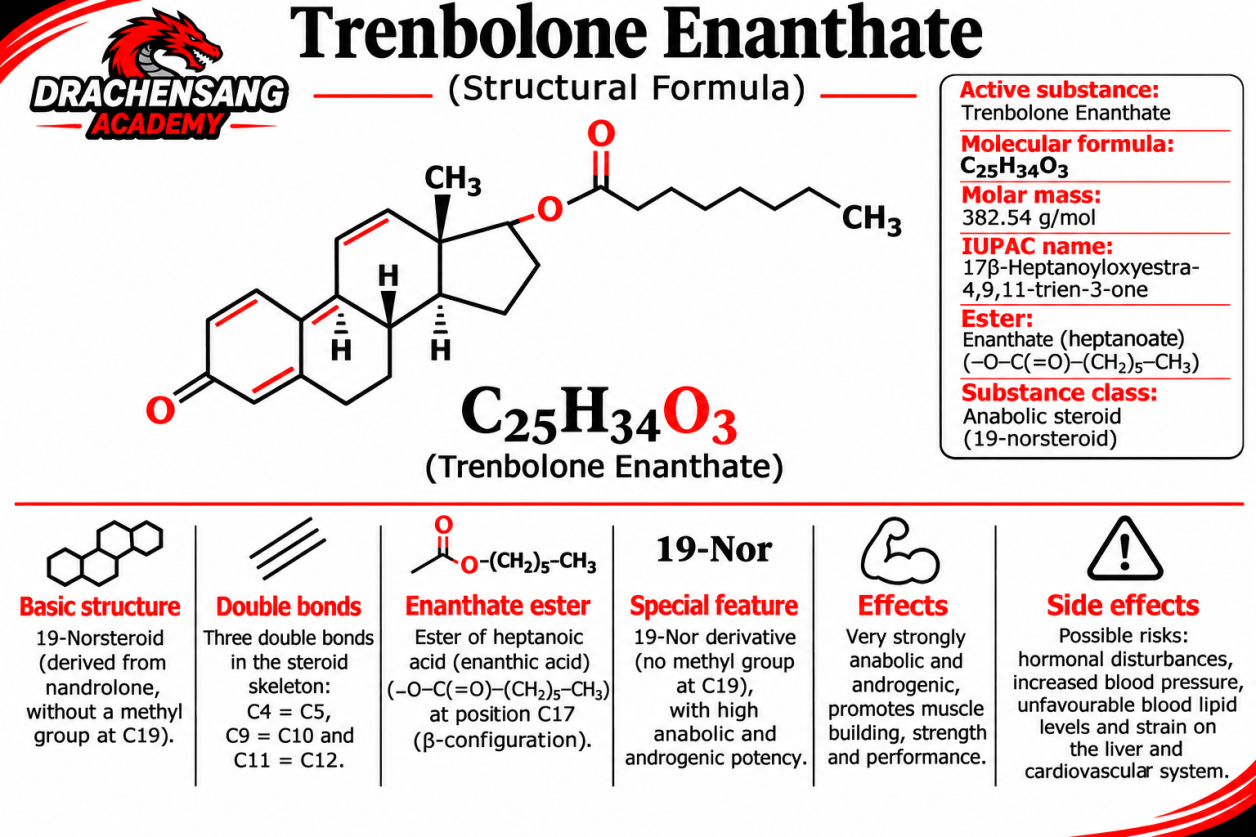
Trenbolone enanthate is an esterified form of trenbolone, a synthetic anabolic-androgenic steroid structurally related to the 19-nortestosterone family.
Its molecular formula is C25H34O3, and its molar mass is approximately 382.54 g/mol.
The enanthate ester is attached to the hydroxyl group at the 17-beta position of the trenbolone molecule.
Esterification changes the chemical properties of the compound and can influence its release and pharmacokinetic behavior.
Following ester cleavage, trenbolone becomes available as the principal biologically active steroid.
The term Trenbolone Enanthate therefore identifies a specific esterified derivative rather than an entirely different androgenic hormone.
However, its actual pharmacokinetic profile in humans has not been established through the same level of clinical research available for approved testosterone preparations.
TRENBOLONE ENANTHATE AND THE ANDROGEN RECEPTOR
Trenbolone acts primarily through interaction with the androgen receptor.
Androgen receptors are involved in biological signaling pathways that influence muscle tissue, protein metabolism, reproductive function, and other androgen-dependent processes.
Experimental studies have demonstrated substantial androgen receptor activity for trenbolone.
However, receptor activity measured in laboratory experiments does not directly establish predictable effects, therapeutic benefits, or safety outcomes in humans.
Trenbolone differs structurally from testosterone and has distinct metabolic characteristics.
Unlike testosterone, trenbolone is generally considered a nonaromatizing anabolic steroid, meaning it is not directly converted into estradiol through the usual aromatase pathway.
This property does not eliminate the possibility of endocrine, reproductive, cardiovascular, or other adverse effects.
Strong androgen receptor activity should not be interpreted as evidence of medical suitability or safety.
WHAT EFFECTS ARE ASSOCIATED WITH TRENBOLONE ENANTHATE?
In bodybuilding and strength-training discussions, trenbolone is commonly associated with:
• Increased muscle development
• Increased strength
• Changes in body composition
• Effects on protein and nitrogen metabolism
• Pronounced anabolic activity
These associations contribute to trenbolone's reputation in performance-oriented sports.
However, much of the available evidence concerning trenbolone's anabolic activity comes from experimental research and veterinary applications rather than controlled human trials of trenbolone enanthate.
Personal reports and bodybuilding claims are not equivalent to established clinical evidence.
The compound's pharmacological activity does not establish that nonmedical use is safe, effective, or medically appropriate.
TRENBOLONE ENANTHATE AND MUSCLE GROWTH
Trenbolone is associated with anabolic biological activity because of its interaction with androgen receptors.
Research involving trenbolone compounds has demonstrated effects on tissue growth and metabolism, particularly in experimental and veterinary settings.
However, findings from livestock production or animal studies cannot automatically be applied to human muscle development.
Controlled human clinical research specifically evaluating trenbolone enanthate is extremely limited.
Consequently, claims concerning exceptional muscle-building effects, predictable strength increases, or specific body-composition advantages should be evaluated cautiously.
A compound with substantial anabolic activity is not necessarily associated with a safer or more beneficial outcome.
Pharmacological potency and established medical benefit are not the same thing.
WHY IS TRENBOLONE ENANTHATE CONSIDERED LONGER-ACTING?
Trenbolone enanthate contains an enanthate ester group, which differs chemically from the shorter acetate ester found in trenbolone acetate.
Esterification can influence absorption, release characteristics, and the duration of exposure following administration.
The enanthate ester is generally associated with more prolonged release characteristics in suitable depot formulations.
However, the actual duration of action depends on the formulation, route of administration, and other pharmacokinetic factors.
Reliable human clinical data establishing a precise duration of action for trenbolone enanthate are limited.
The ester name alone is not sufficient to establish an exact human half-life or a predictable safety profile.
TRENBOLONE ENANTHATE VS. TRENBOLONE ACETATE
Both compounds are esterified derivatives of trenbolone.
Their principal chemical difference involves the ester group attached to the underlying trenbolone structure.
Trenbolone Enanthate
• Contains an enanthate ester
• Has a longer ester chain
• May provide more prolonged release in suitable formulations
• Lacks an established human medical indication
Trenbolone Acetate
• Contains an acetate ester
• Has a shorter ester chain
• Has been used in certain veterinary cattle implant products
• Is not approved for human medical use
Both derivatives can release trenbolone following ester cleavage.
However, differences in ester structure should not be interpreted as evidence that either compound is safe for human bodybuilding or performance enhancement.
WHY TRENBOLONE ENANTHATE IS NOT TESTOSTERONE REPLACEMENT THERAPY
Testosterone is a naturally occurring hormone with established medical applications in appropriately selected patients.
Certain prescription testosterone preparations are approved for treating clinically confirmed testosterone deficiency.
Trenbolone enanthate is chemically and pharmacologically distinct from testosterone and does not have an equivalent established therapeutic role in human medicine.
It is not an FDA-approved testosterone replacement medication.
The presence of a compound in chemical databases, scientific publications, or regulatory reference materials does not establish medical approval.
Trenbolone enanthate should not be confused with medically approved testosterone replacement therapy.
WHAT POTENTIAL HEALTH RISKS ARE ASSOCIATED WITH TRENBOLONE?
Nonmedical anabolic-androgenic steroid use has been associated with adverse effects involving multiple physiological systems.
Potential concerns relevant to trenbolone exposure include:
• Suppression of natural testosterone production
• Reduced sperm production
• Potential impairment of fertility
• Changes in libido and sexual function
• Acne and increased skin oiliness
• Hair loss in genetically predisposed individuals
• Unfavorable changes in blood lipid levels
• Elevated blood pressure
• Possible cardiovascular complications
• Mood and behavioral changes
• Other endocrine disturbances
The available evidence differs between individual outcomes.
Many concerns are supported by research on anabolic-androgenic steroid exposure generally rather than by large controlled human studies specifically involving trenbolone enanthate.
Because the compound has not undergone conventional clinical development for human use, its complete adverse-effect profile remains insufficiently characterized.
Limited human research does not establish that trenbolone enanthate is safe.
EFFECTS ON HORMONES AND FERTILITY
External anabolic-androgenic steroids can interfere with the body's natural endocrine regulation.
In men, testosterone production is controlled through the hypothalamic-pituitary-gonadal (HPG) axis.
Exogenous androgen exposure can suppress the release of luteinizing hormone (LH) and follicle-stimulating hormone (FSH).
This suppression can reduce natural testosterone production and impair sperm production.
Potential consequences include:
• Reduced endogenous testosterone production
• Testicular atrophy
• Reduced sperm count
• Fertility problems
• Changes in sexual function
• Symptoms of hormonal deficiency after discontinuation
Recovery of normal reproductive hormone function varies between individuals and may take considerable time.
These concerns are particularly relevant for people planning to have children.
POTENTIAL ANDROGENIC EFFECTS IN WOMEN
Anabolic-androgenic steroids can also cause hormonal disturbances in women.
Potential androgen-related effects include:
• Acne and increased skin oiliness
• Increased facial or body hair
• Menstrual irregularities
• Scalp hair changes
• Voice deepening
• Other signs of virilization
Some androgen-related changes may be persistent or irreversible.
The frequency and severity of these effects following trenbolone enanthate exposure have not been adequately established through human clinical studies.
THE CARDIOVASCULAR SYSTEM AND BLOOD LIPIDS
Anabolic-androgenic steroid exposure can affect the cardiovascular system and blood lipid metabolism.
Research involving nonmedical AAS use has identified associations with:
• Increased blood pressure
• Reduced HDL cholesterol
• Unfavorable changes in LDL cholesterol
• Changes in cardiac structure
• Impaired cardiac function
• Other cardiovascular complications
These changes may develop without obvious symptoms.
However, findings from studies involving multiple anabolic steroids cannot automatically be attributed specifically to trenbolone enanthate.
The precise cardiovascular risk profile of trenbolone enanthate in humans remains insufficiently established.
Visible muscle development does not provide a reliable indication of cardiovascular health.
PSYCHOLOGICAL AND NEUROLOGICAL ASPECTS
Nonmedical anabolic-androgenic steroid use has been associated with psychological and behavioral changes.
Reported concerns include:
• Irritability
• Mood instability
• Anxiety symptoms
• Increased aggression in some individuals
• Sleep disturbances
• Depressive symptoms following discontinuation
These effects do not occur uniformly in every individual.
The relationship between androgen exposure and psychological outcomes is influenced by multiple biological and behavioral factors.
Evidence specifically quantifying these risks for trenbolone enanthate remains limited.
TRENBOLONE ENANTHATE AND DOPING
Trenbolone falls within the scope of the World Anti-Doping Agency (WADA) Prohibited List under S1 – Anabolic Agents.
Its use is prohibited both in and out of competition under applicable anti-doping rules.
Athletes should not assume that the absence of an approved human medical indication changes the compound's prohibited status.
Anti-doping regulations must be considered separately from medical approval and general product availability.
WHY "POTENT" DOES NOT MEAN "BETTER"
Trenbolone is often described as a potent anabolic-androgenic steroid.
However, pharmacological potency refers to biological activity under specific conditions and does not establish greater safety, effectiveness, or therapeutic value.
Strong androgen receptor activity can influence multiple physiological systems beyond skeletal muscle.
Potential consequences involving hormonal regulation, fertility, cardiovascular health, and psychological well-being must therefore be considered alongside claims about anabolic effects.
Greater biological activity does not automatically translate into a better or safer outcome.
TRENBOLONE ENANTHATE: KEY FACTS AT A GLANCE
Important characteristics of trenbolone enanthate include:
• Synthetic anabolic-androgenic steroid derivative
• Enanthate ester of trenbolone
• Molecular formula: C25H34O3
• Molar mass: approximately 382.54 g/mol
• Ester group attached at the 17-beta position
• Androgen receptor activity associated with released trenbolone
• No FDA-approved human medical indication
• Limited controlled human clinical evidence
• Potential suppression of natural hormone production
• Possible impairment of sperm production and fertility
• Potential cardiovascular and endocrine complications
• Prohibited status under WADA anti-doping regulations
These characteristics illustrate why trenbolone enanthate should be evaluated as a pharmacologically active steroid compound rather than an ordinary fitness product.
IMPORTANT SAFETY INFORMATION
Drachensang Academy Global provides this article exclusively for general educational and informational purposes.
Trenbolone enanthate is a synthetic anabolic-androgenic steroid derivative and is not approved for human medical use in the United States.
Nonmedical exposure may involve significant endocrine, cardiovascular, reproductive, and psychological health risks.
This article does not recommend trenbolone use and does not provide dosage schedules, injection instructions, steroid cycles, or combination recommendations.
The information does not replace professional medical advice, diagnosis, or treatment.
Anyone experiencing possible adverse effects, hormonal symptoms, or concerns related to anabolic steroid exposure should consult a qualified healthcare professional.
CONCLUSION: TRENBOLONE ENANTHATE IN PERSPECTIVE
Trenbolone Enanthate is an esterified derivative of trenbolone, a synthetic anabolic-androgenic steroid associated with bodybuilding and nonmedical performance enhancement.
Its enanthate ester influences the compound's chemical and potential release characteristics, while trenbolone provides the principal androgenic activity following ester cleavage.
Although experimental research demonstrates substantial androgen receptor activity, controlled human clinical evidence for trenbolone enanthate remains extremely limited.
Potential concerns associated with anabolic-androgenic steroid exposure include suppression of natural hormone production, impaired fertility, unfavorable blood lipid changes, elevated blood pressure, and cardiovascular complications.
Trenbolone enanthate should therefore be understood as a pharmacologically active steroid with no approved human medical indication in the United States and potentially serious risks associated with nonmedical use.