Winstrol (Stanozolol): Effects, Properties and Risks
Winstrol is a brand name historically associated with stanozolol, a synthetic anabolic-androgenic steroid (AAS).
The compound has a history of medical use and is widely discussed in bodybuilding, strength training, competitive sports, and anti-doping contexts.
Stanozolol is often associated with increased muscle definition, strength, and a leaner-looking physique. However, these claims must be evaluated alongside its documented and potential health risks.
Particular concerns include liver injury, unfavorable changes in blood lipid levels, cardiovascular complications, and suppression of natural hormone production.
This article from Drachensang Academy Global examines the compound's chemical properties, pharmacological activity, historical medical applications, and health risks from an educational perspective.
WHAT IS WINSTROL (STANOZOLOL)?
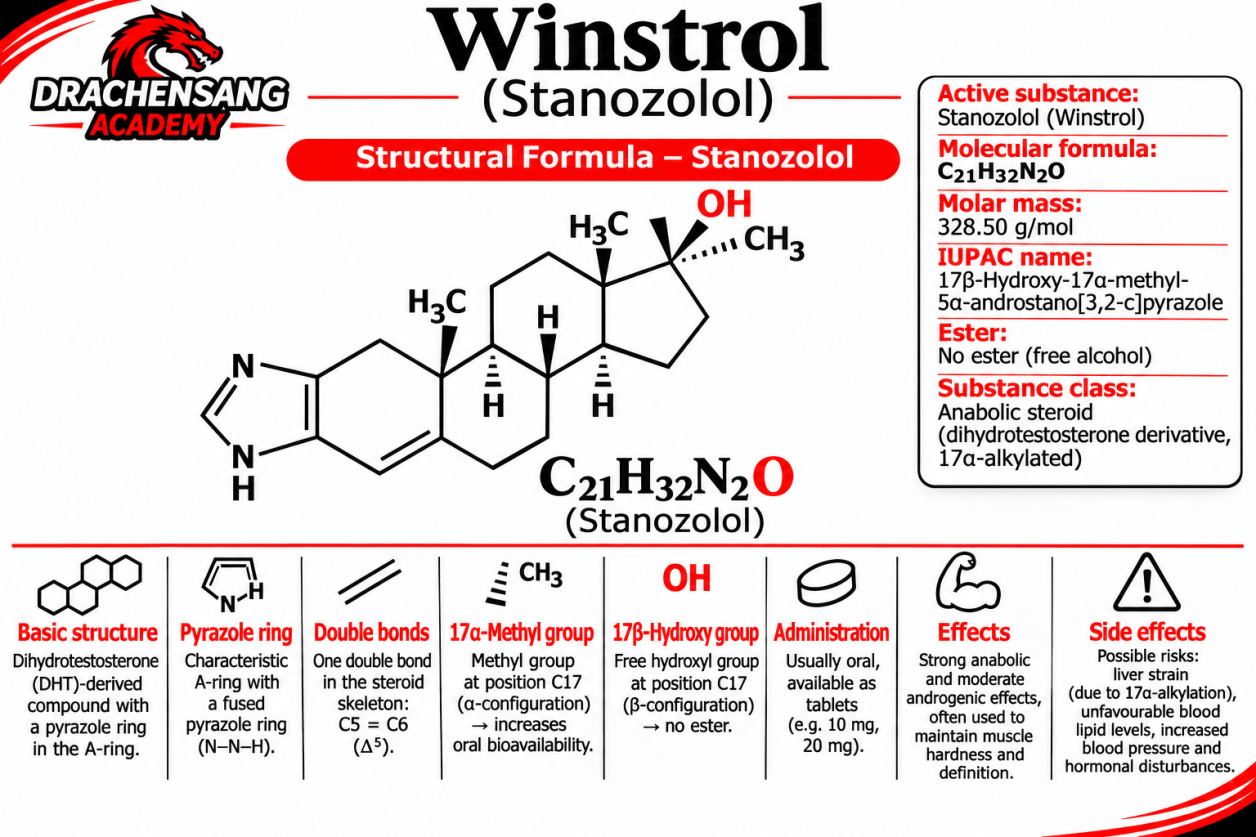
Stanozolol is a synthetic anabolic-androgenic steroid structurally derived from dihydrotestosterone (DHT).
Its molecular formula is C21H32N2O, and its molar mass is approximately 328.50 g/mol.
A distinctive feature of stanozolol is its pyrazole ring fused to the steroid structure.
The compound also contains a 17-alpha-methyl group, making it a 17-alpha-alkylated anabolic steroid.
This chemical modification contributes to its oral activity but is also relevant to its potential for liver toxicity.
Stanozolol has anabolic and androgenic properties, meaning it can influence biological processes associated with tissue development and androgen receptor signaling.
Its chemical and pharmacological characteristics distinguish it from testosterone and many other anabolic-androgenic steroids.
HOW DOES STANOZOLOL WORK IN THE BODY?
Stanozolol exerts important biological effects through interaction with the androgen receptor.
Androgen receptor activation influences gene expression and physiological processes involved in protein metabolism, muscle tissue, and other androgen-dependent functions.
Stanozolol has both anabolic and androgenic activity, although the relative expression of these effects depends on the biological system being studied.
Experimental measurements of anabolic activity cannot automatically be translated into predictable benefits or safety outcomes in humans.
Unlike testosterone, stanozolol is not converted into estradiol through the usual aromatase pathway.
However, its nonaromatizing characteristics do not eliminate the possibility of significant endocrine disturbances.
Stanozolol remains a hormonally active anabolic steroid with potential effects extending far beyond skeletal muscle.
WINSTROL AND MUSCLE DEVELOPMENT
In bodybuilding, Winstrol is commonly associated with muscle definition, strength, and changes in physical appearance.
These associations are related to stanozolol's anabolic-androgenic activity and its historical use in performance-oriented sports.
However, claims about a uniquely hard or dry muscular appearance are largely associated with bodybuilding terminology and should not be treated as established clinical outcomes.
Changes in muscle appearance depend on several factors, including:
• Muscle mass
• Body-fat percentage
• Nutrition and energy balance
• Training status
• Fluid balance
• Individual physiological characteristics
A substance's ability to influence androgen-dependent processes does not establish that nonmedical use is safe or medically appropriate.
Visible changes in physique should never be interpreted as proof of overall health or physiological safety.
IS WINSTROL A FAT BURNER?
Winstrol is sometimes described in bodybuilding discussions as a compound associated with a leaner or more defined appearance.
However, stanozolol is not a conventional fat-burning supplement or an approved weight-loss medication.
There is insufficient high-quality clinical evidence to support its use as a safe or effective treatment for reducing body fat.
Visible muscle definition is primarily influenced by the relationship between muscle development and body-fat levels.
For sustainable fat management, the most important factors remain:
• Appropriate energy intake
• Balanced nutrition
• Resistance training
• Regular physical activity
• Adequate sleep and recovery
Stanozolol should not be presented as a medically validated fat-loss strategy.
IS STANOZOLOL A TESTOSTERONE DERIVATIVE?
Stanozolol is structurally classified as a dihydrotestosterone-derived anabolic-androgenic steroid.
Although testosterone and stanozolol belong to the broader androgen family, they are chemically distinct compounds.
Stanozolol contains structural modifications that influence its pharmacological and metabolic characteristics.
Unlike testosterone, it does not undergo conventional aromatization to estradiol.
This does not mean that stanozolol has no effect on the body's hormonal balance.
External anabolic-androgenic steroids can suppress natural reproductive hormone signaling and interfere with endogenous testosterone production.
HISTORICAL MEDICAL USE OF STANOZOLOL
Stanozolol has a history of medical use, including certain conditions involving hereditary angioedema.
Its historical therapeutic applications must be distinguished from its nonmedical use in bodybuilding and competitive sports.
The fact that a substance has previously been used in medicine does not establish that it is currently an appropriate or approved treatment for every condition.
Regulatory approval and product availability can change over time and differ between countries.
In the United States, the historical Winstrol brand and its former medical applications should not be interpreted as confirmation that an FDA-approved stanozolol product is currently marketed.
Any discussion of medical treatment should be based on current product authorization and qualified professional assessment.
WINSTROL AND LIVER HEALTH
The potential for liver injury is one of the most important documented concerns associated with stanozolol.
Stanozolol is a 17-alpha-alkylated anabolic steroid, a chemical characteristic associated with an increased risk of certain forms of hepatotoxicity.
Medical case reports have documented serious liver complications associated with stanozolol exposure.
Potential liver-related problems include:
• Elevated liver enzymes
• Cholestatic liver injury
• Jaundice
• Impaired bile flow
• Other forms of drug-induced liver injury
Severe liver injury can occur even when initial symptoms are nonspecific.
Warning signs may include unusual fatigue, itching, dark urine, pale stools, yellowing of the skin or eyes, and abdominal discomfort.
Importantly, liver enzyme measurements do not always reflect the full severity of cholestatic injury.
Long-term exposure to certain anabolic steroids has also been associated with uncommon but serious hepatic complications.
Stanozolol-associated liver toxicity is a documented medical concern, not merely a theoretical risk.
ORAL AND INJECTABLE STANOZOLOL: SAFETY CONSIDERATIONS
Stanozolol has historically existed in different pharmaceutical formulations, including oral and injectable preparations.
However, the existence of different formulations does not eliminate the compound's underlying pharmacological risks.
Its 17-alpha-alkylated chemical structure remains relevant regardless of whether the substance is discussed in an oral or injectable context.
The actual risk of adverse effects depends on multiple factors, including the formulation, exposure, individual health status, and other substances involved.
Injectable stanozolol should not automatically be considered harmless to the liver or safer than oral preparations.
EFFECTS ON CHOLESTEROL AND CARDIOVASCULAR HEALTH
Stanozolol can have unfavorable effects on the blood lipid profile.
Clinical research has documented substantial reductions in HDL cholesterol and changes in other lipid parameters during stanozolol exposure.
HDL cholesterol is commonly described as good cholesterol because it participates in processes involved in cholesterol transport and metabolism.
Unfavorable changes in HDL and LDL cholesterol may contribute to cardiovascular risk.
Anabolic-androgenic steroid use has also been associated with:
• Elevated blood pressure
• Unfavorable lipid profiles
• Changes in cardiac structure
• Impaired cardiac function
• Other cardiovascular complications
Not every cardiovascular outcome has been established specifically for stanozolol through large controlled clinical studies.
Nevertheless, its documented effects on lipid metabolism are an important part of the compound's risk profile.
A muscular or athletic appearance does not rule out unfavorable cardiovascular changes.
WINSTROL AND NATURAL TESTOSTERONE PRODUCTION
Anabolic-androgenic steroids can interfere with the body's natural hormonal feedback mechanisms.
In men, endogenous testosterone production is regulated through the hypothalamic-pituitary-gonadal (HPG) axis.
External androgen exposure can suppress the release of luteinizing hormone (LH) and follicle-stimulating hormone (FSH).
Potential consequences include:
• Reduced endogenous testosterone production
• Testicular atrophy
• Reduced sperm production
• Changes in libido
• Sexual dysfunction
• Potential impairment of fertility
The severity and duration of these effects can vary considerably between individuals.
Recovery after discontinuation may take time and cannot be predicted reliably in every case.
Hormonal suppression is an important concern even when anabolic steroids are used for nonmedical physique-related goals.
POTENTIAL EFFECTS IN WOMEN
Women exposed to anabolic-androgenic steroids may experience androgen-related adverse effects.
Potential changes include:
• Acne and increased skin oiliness
• Increased facial or body hair
• Menstrual irregularities
• Changes in scalp hair growth
• Voice deepening
• Other signs of virilization
Some androgen-related changes, particularly voice deepening, may be persistent or irreversible.
The severity of these effects depends on the individual circumstances of exposure and other physiological factors.
OTHER POTENTIAL SIDE EFFECTS OF WINSTROL
Beyond liver toxicity and cardiovascular concerns, stanozolol exposure may involve additional adverse effects.
Potential effects include:
• Acne and other skin changes
• Hair loss in genetically predisposed individuals
• Changes in sexual function
• Suppression of reproductive hormone production
• Mood or behavioral changes
• Potential fertility impairment
• Other androgen-related complications
Some reported effects are supported by evidence involving anabolic-androgenic steroids as a broader category rather than by large controlled studies of stanozolol specifically.
A scientifically responsible assessment should distinguish compound-specific findings from broader AAS-associated risks.
WHY IS WINSTROL WELL KNOWN IN BODYBUILDING?
Winstrol became widely recognized through its association with performance-oriented sports and bodybuilding.
Its reputation is often connected to claims about muscle definition, strength, and changes in physical appearance.
However, bodybuilding terminology and anecdotal reports should not be confused with controlled medical evidence.
The history of a substance in competitive sports does not establish that its nonmedical use is safe.
Reliable scientific evidence and documented health risks should take priority over promotional claims or personal experiences.
WINSTROL IN COMPETITIVE SPORTS AND DOPING
Stanozolol is included on the World Anti-Doping Agency (WADA) Prohibited List under S1 – Anabolic Agents.
Its use is prohibited both in and out of competition under applicable anti-doping regulations.
Stanozolol has also been involved in well-known historical doping cases, contributing to its public recognition in competitive sports.
Athletes should consult the current rules of their governing organizations and relevant anti-doping authorities.
The regulatory consequences of using prohibited substances are separate from their potential medical and physiological risks.
WINSTROL (STANOZOLOL): KEY FACTS AT A GLANCE
Important characteristics of stanozolol include:
• Synthetic anabolic-androgenic steroid
• Historically associated with the Winstrol brand
• Dihydrotestosterone-derived chemical structure
• Molecular formula: C21H32N2O
• Molar mass: approximately 328.50 g/mol
• Distinctive fused pyrazole ring
• 17-alpha-alkylated steroid structure
• Anabolic and androgenic activity
• Historical medical applications
• Documented potential for liver injury
• Documented unfavorable effects on blood lipids
• Potential suppression of natural hormone production
• Possible impairment of fertility
• Prohibited status under WADA anti-doping regulations
These characteristics demonstrate why stanozolol should be evaluated as a pharmacologically active steroid rather than a conventional fitness or weight-loss product.
IMPORTANT SAFETY INFORMATION
Drachensang Academy Global provides this article exclusively for general educational and informational purposes.
Winstrol (stanozolol) is a synthetic anabolic-androgenic steroid and is not an ordinary dietary supplement.
Nonmedical use can involve significant health risks, particularly involving the liver, cardiovascular system, lipid metabolism, and hormonal regulation.
This article does not recommend stanozolol use and does not provide dosage schedules, steroid cycles, injection instructions, or acquisition recommendations.
The information does not replace professional medical advice, diagnosis, or treatment.
Anyone experiencing symptoms suggestive of liver injury, hormonal disturbances, cardiovascular problems, or other adverse effects should seek appropriate medical evaluation.
CONCLUSION: WINSTROL IN PERSPECTIVE
Winstrol (Stanozolol) is a synthetic anabolic-androgenic steroid with a distinctive chemical structure and a history of medical and nonmedical use.
Its anabolic and androgenic properties explain its association with muscle development, strength training, bodybuilding, and competitive sports.
However, stanozolol's potential effects on physical appearance must be considered alongside its documented health risks.
Particular concerns include cholestatic liver injury, unfavorable changes in cholesterol metabolism, cardiovascular complications, and suppression of natural reproductive hormone production.
Stanozolol should therefore be understood as a pharmacologically active anabolic steroid with significant potential health risks, not as a harmless fitness supplement or a medically established fat-loss product.